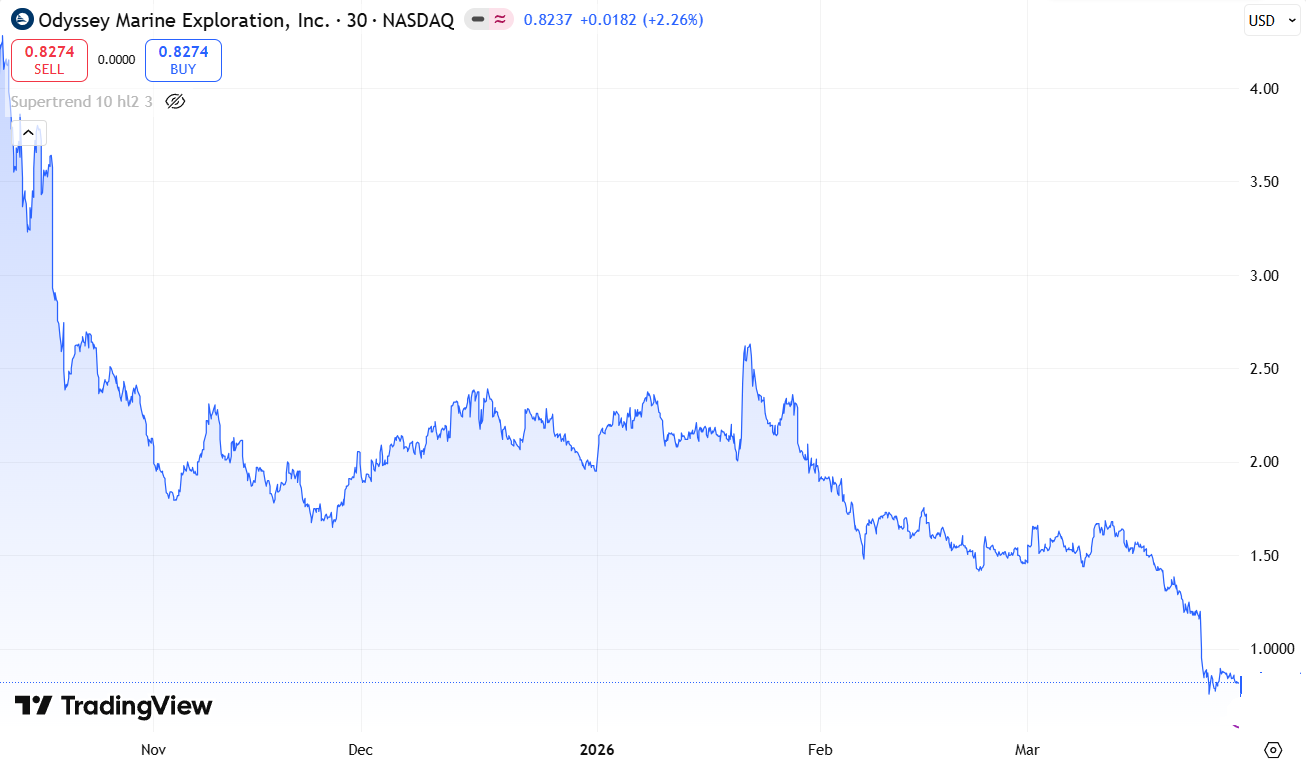
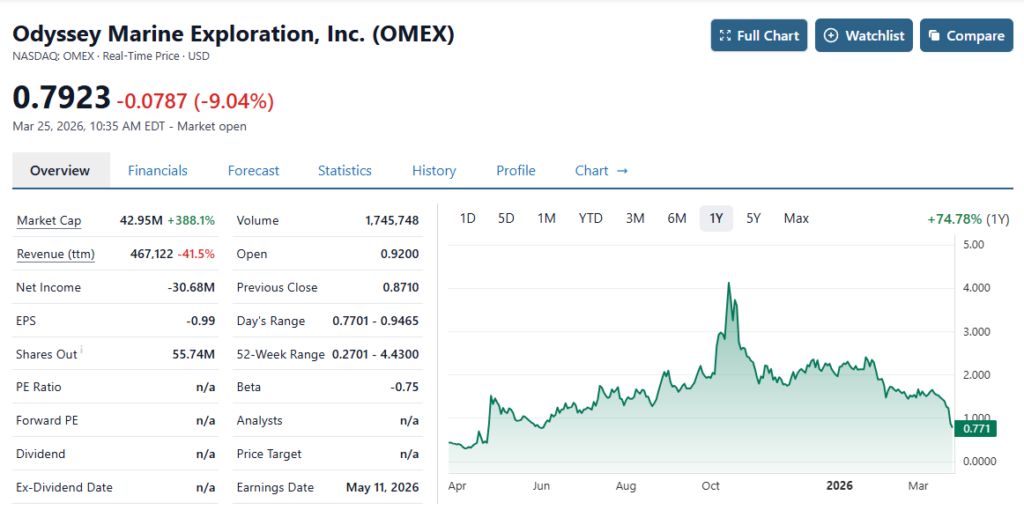
Odyssey Marine (OMEX) $0.80 and Advanced Gold Exploration (AUEX)
ODYSSEY MARINE
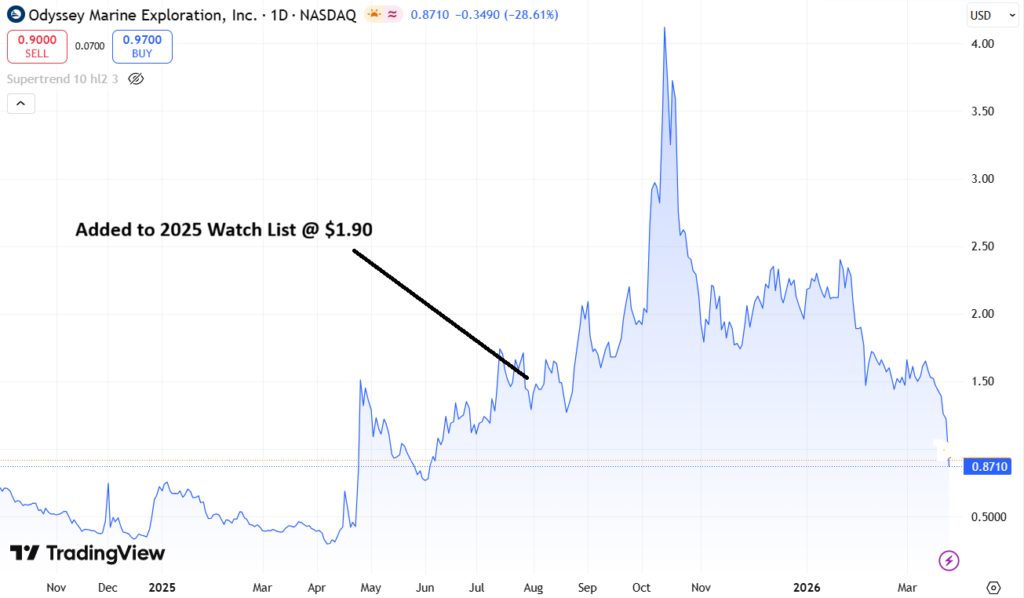
No doubt we were having fun for a while there with Odyssey (OMEX) when it gained 133% six weeks after we added it to the 2025 Precious Metals Watch List, trading from $1.90 to $4.43. Nothing in the story has changed.
As a reminder, Odyssey’s first plunge was in the fall of 2024 (September 17) when it dropped from $5 to under $1.00 AFTER it won a lawsuit for $37.1 million. The problem was that they were claiming damages of $1.3 billion. A tad disappointing to say the least.
Odyssey sought to develop a large underwater phosphate deposit off the coast of Baja California Sur, Mexico. Their subsidiary, Exploraciones Oceánicas (ExO), held a 50‑year concession to mine the seabed for phosphate—an important ingredient in fertilizers and other products. To begin operations, the company needed environmental permits from Mexico’s environmental agency, SEMARNAT.
Odyssey argued that they spent years preparing a scientifically supported environmental impact assessment and development plan. They claimed the project would be economically beneficial and environmentally responsible, with minimal impact on fisheries or marine ecosystems. However, SEMARNAT denied the environmental permit twice—first in 2016 and again in 2018—citing environmental risks to marine life, including endangered species and local fishing communities.
Odyssey believed these denials were arbitrary, politically influenced, and not based on scientific evidence. They argued that Mexico’s actions violated protections guaranteed under NAFTA, including fair and equitable treatment. Because of this, Odyssey filed an international arbitration claim seeking compensation for the lost value of the project.
Mexico defended its decision by pointing to serious environmental concerns. The proposed mining area overlapped with critical habitats for whales, sea turtles, and local fisheries. Environmental groups and fishing cooperatives strongly opposed the project, warning that dredging the seabed would cause pollution, sediment disruption, and long‑term ecological damage.
In the end, the arbitration tribunal agreed partly with Odyssey, ruling that Mexico had not treated the company fairly under NAFTA. Although Odyssey originally sought over a billion dollars, the tribunal awarded $37.1 million, far less than the claim but still significant. The ruling sparked debate about whether international arbitration allows corporations to override environmental protections.
Fast forward to today “Why Speculators Piled In During the Run-Up“
Speculators were largely betting that Odyssey Marine Exploration was on the verge of a major regulatory breakthrough. Around that time, the company was actively pursuing approvals and government recognition for its subsea mineral projects, including phosphate and other critical minerals. Traders interpreted each press release or policy signal—especially anything involving U.S. government interest in critical minerals—as a sign that OMEX might finally unlock long‑delayed project value. This created a narrative that regulatory momentum was shifting in the company’s favor.
Another major driver was the broader market excitement around critical minerals, battery metals, and undersea resource development. As global demand for these materials surged, investors began searching for small‑cap companies that could benefit from the trend. OMEX, despite its long history of setbacks, fit the profile of a “lottery ticket” play: tiny market cap, huge theoretical resource value, and a storyline tied to national resource security. This made it attractive to momentum traders looking for asymmetric upside.
Speculators also reacted to the company’s announcements about new project submissions, offshore mineral lease requests, and successful equipment deployments. Even routine operational updates were interpreted as signs that OMEX was progressing toward commercial viability. In thinly traded microcaps, this kind of sentiment can snowball quickly—especially when social‑media‑driven trading communities amplify the story. The stock’s rapid rise itself became a catalyst, pulling in more traders who feared missing out.
Finally, some investors were betting that the NAFTA arbitration outcome—though already known—might lead to additional legal, political, or financial leverage for OMEX. The belief was that the $37.1 million award validated the company’s claims and strengthened its credibility with regulators and partners. Combined with hopes for new U.S. government support for domestic mineral supply chains, this created a speculative environment where traders convinced themselves that OMEX was positioned for a transformational re‑rating, even if the fundamentals had not yet changed.
Why the Run Didn’t Hold
The rally ultimately collapsed because the underlying fundamentals never caught up with the speculative enthusiasm. Traders were bidding the stock up on potential regulatory breakthroughs, but no concrete approvals, partnerships, or government commitments materialized during the run. In microcaps, momentum can carry a stock only so far; once the news flow cooled and no major catalysts arrived, the excitement faded. Without a real operational milestone to anchor the valuation, the stock drifted back toward levels that reflected uncertainty rather than optimism.
Another factor was the company’s long history of delays, regulatory setbacks, and capital constraints. Many investors who bought early in the run used the spike as an opportunity to exit positions they had been holding for years. This created persistent selling pressure at higher levels. As soon as the stock lost upward momentum, profit‑taking accelerated, and the absence of institutional buyers meant there was no deep pool of demand to absorb the selling. The stock’s thin liquidity amplified every move downward.
The broader market environment also played a role. Speculative small‑caps were hit hard as interest rates stayed high and risk appetite cooled. OMEX, which relies heavily on future‑value narratives rather than current revenue, became a casualty of that shift. When traders rotate out of high‑risk names, companies without near‑term cash flow or regulatory clarity tend to fall the fastest. OMEX’s story simply wasn’t strong enough at that moment to resist the macro headwinds.
Finally, the NAFTA arbitration award — while meaningful — was far smaller than the billion‑dollar claim that some speculators had anchored their hopes to. Once the dust settled, investors realized the award did not fundamentally change the company’s long‑term regulatory challenges or guarantee future project approvals. The gap between expectations and reality became too wide to sustain the inflated share price, and the stock reverted to a level more consistent with uncertainty rather than transformation.
What OMEX Would Realistically Need Going Forward
For OMEX to regain momentum, the company would need a clear, credible regulatory breakthrough on one of its subsea mineral projects. This means not just submitting applications, but receiving formal approvals or advancing to a defined next stage with a government agency. Investors need evidence that the years of environmental and political friction are finally giving way to progress. Without regulatory traction, the story remains theoretical.
A second major catalyst (our bet, our dream) would be a strategic partnership with a well‑capitalized industrial or government‑aligned entity. Deep‑sea mineral development is expensive, politically sensitive, and technologically complex. A partnership with a recognized mining, energy, or defense‑related organization would signal that OMEX’s projects have external validation and financial backing. This kind of partnership would also reduce investor fears about dilution, which has historically weighed on the stock.
OMEX would also benefit from transparent, independently verified resource data. Speculators love big theoretical numbers, but institutions require third‑party validation of resource size, grade, and economic feasibility. Updated NI 43‑101‑style reports, environmental impact studies, or engineering assessments would give the market something concrete to model. Without this, the valuation remains tied to hope rather than measurable value.
Finally, the company needs a consistent, credible communication strategy that avoids over‑promising and instead focuses on measurable milestones. Microcaps often lose investor trust by leaning too heavily on promotional language. If OMEX can demonstrate steady progress — even small steps — and back it with documentation, the market will begin to reprice the company based on execution rather than speculation. In short, the next rally will only stick if it’s built on substance rather than sentiment.
Bull Case: A Regulatory Breakthrough Unlocks the Story
In the most optimistic scenario (and we are optimists), OMEX secures a meaningful regulatory advancement on one of its subsea mineral projects. This doesn’t have to be full approval — even a formal acceptance into a defined review phase, a positive environmental assessment milestone, or a government‑backed pilot program would be enough to re‑ignite interest. If the company can demonstrate that years of friction with regulators are finally easing, the market would quickly reprice the stock upward. In this scenario, OMEX becomes a legitimate participant in the critical‑minerals supply chain rather than a speculative long shot.
A bull case also assumes OMEX lands a strategic partnership with a well‑capitalized industrial or government‑aligned entity. A partner with deep pockets and political credibility would validate the company’s technology, reduce financing risk, and signal that the project has real-world viability. This combination — regulatory traction plus external validation — is the formula that could push OMEX into a sustained re‑rating rather than another short-lived spike.
While not what we are looking for, we note Odyssey is collaborating with Great Lakes Dredge & Dock Corporation (NASDAQ: GLDD) to provide dredging services if and when the “Virginia” project advances. You can read more about that here: Odyssey Marine Exploration’s Unsolicited Request for a U.S. Offshore Mineral Lease
Base Case: Slow Progress, Occasional Pops, but No Breakthrough Yet
The base case is that OMEX continues making incremental progress but without a decisive regulatory win. The company may submit additional studies, refine environmental plans, or engage in new government dialogues, but nothing crosses the threshold into a true catalyst. In this scenario, the stock trades sideways with occasional bursts of speculative activity whenever a new filing, update, or rumor surfaces. Traders treat it as a “story stock” — capable of sharp moves, but lacking the substance to hold them.
This path keeps the company alive and moving, but it doesn’t fundamentally change investor perception. OMEX remains dependent on future approvals, future partnerships, and future funding. The market waits for something concrete, and until that arrives, the valuation stays capped. This is the most common trajectory for microcaps with long regulatory timelines.
Bear Case: Continued Delays, Financing Pressure, and Erosion of Confidence
In the bear case, regulatory agencies remain unmoved, environmental concerns persist, and OMEX struggles to demonstrate measurable progress. Without forward motion, the company may need to raise capital under unfavorable terms, leading to dilution that weighs heavily on the share price. Investor fatigue deepens, and the stock drifts lower as the market loses patience with the long timeline and uncertain outcomes.
This scenario doesn’t require a catastrophic event — just continued stagnation. Microcaps often suffer not from bad news, but from no news. If OMEX cannot produce verifiable milestones, updated resource data, or credible partnerships, the narrative weakens and the stock becomes increasingly vulnerable to selling pressure. The company survives, but the market stops believing in the upside.
What to Watch For: The Signals That Actually Matter
Regardless of which scenario plays out, the key indicators are the same. First, look for formal regulatory steps, not just submissions or meetings — anything that shows the process is advancing. Second, watch for third‑party validation, whether through partnerships, engineering studies, or independent resource assessments. Third, monitor the company’s capital strategy; healthy financing signals confidence, while distressed financing signals risk. Finally, pay attention to communication quality — clear, measured updates indicate discipline, while vague or promotional language often signals a lack of real progress.
Where OMEX Stands Now
The story is ultimately about execution vs. expectation. Last fall’s surge was powered by hope, momentum, and narrative. The fade was powered by reality, timelines, and the absence of concrete milestones. That tension — between potential and proof — is the entire OMEX investment thesis in one sentence.
What Actually Moves the Needle From Here
Everything going forward hinges on three things:
- Regulatory traction that goes beyond filings and enters formal review stages.
- Third‑party validation — partnerships, engineering studies, or independently verified resource data.
- A credible capital strategy that avoids desperation financing and signals confidence.
If OMEX can deliver even one of these, the market will notice. If it can deliver two, the stock will reprice. If it delivers none, the story stays stuck in neutral.
How to Think About the Path Ahead
The bull, base, and bear scenarios we laid out give investors a realistic framework — not predictions, but lenses. The bull case requires real-world traction. The base case is slow grind with occasional speculative pops. The bear case is stagnation and dilution. The difference between them isn’t luck; it’s milestones. OMEX’s future is determined by whether it can convert narrative into documented progress.
Stay tuned for more.
Original Post (2025) Adding Odyssey Marine (OMEX) $1.96 and The Metals Company (TMC) $5.36 to Watch List.
ADVANCED GOLD EXPLORATION
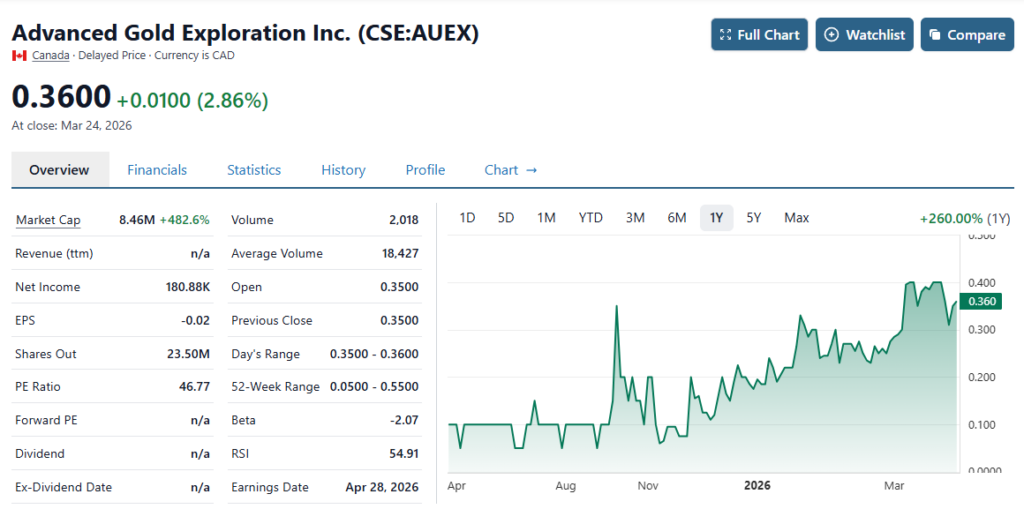
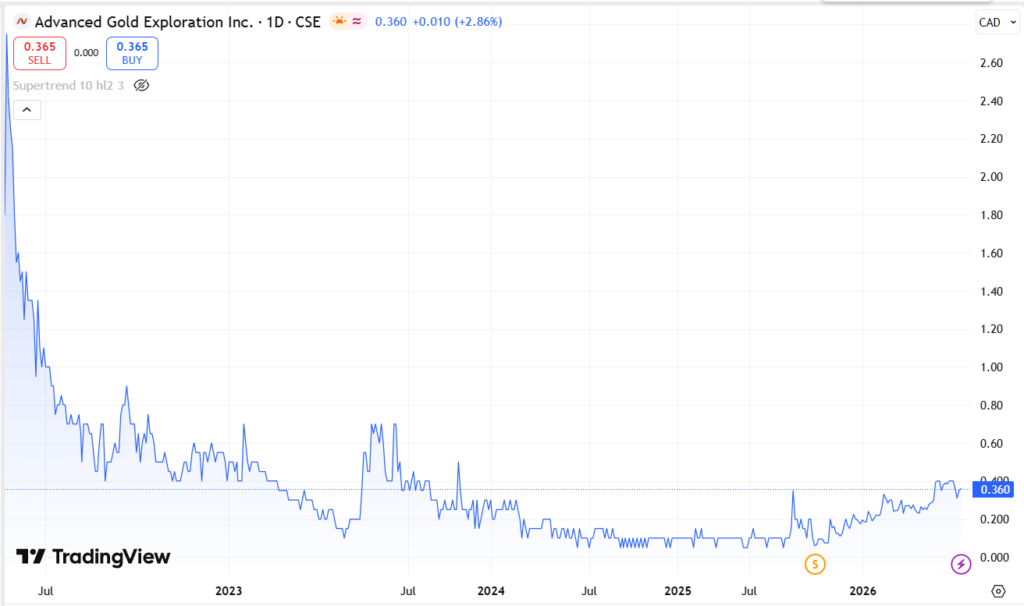
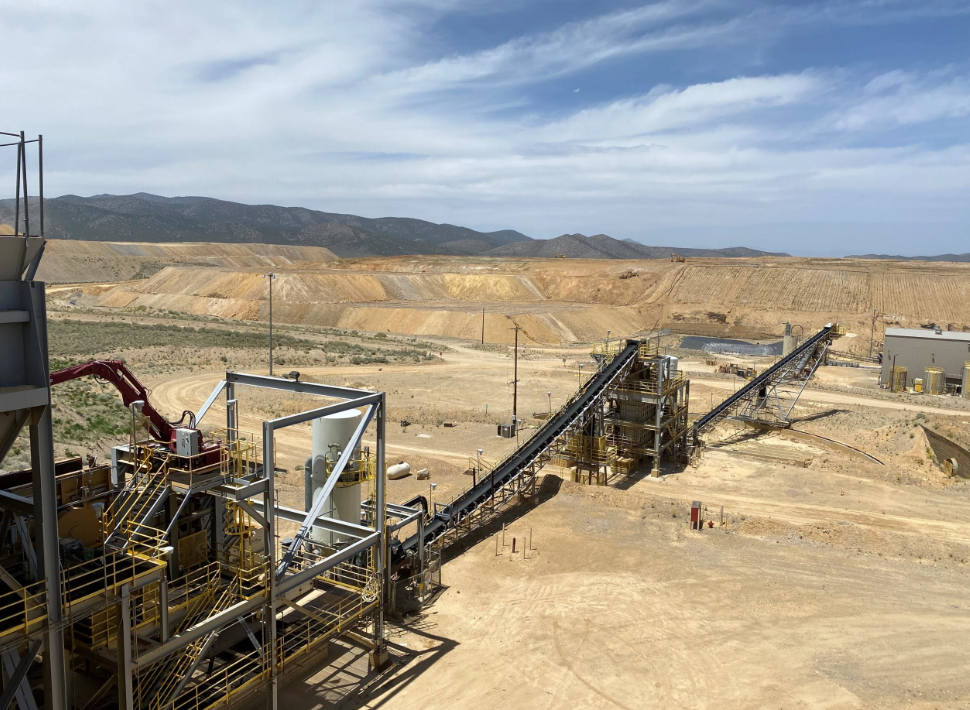
Advanced Gold (AUEX, AUHIF) comes to us from a good friend and long-time analyst from Vancouver (of course). We’ll go into greater detail in the weeks and months ahead, but for now, we’ll simply pass along an article he passed along to us.
What excites him most is the recently announced acquisition of what’s called the Silver Belle project in Nevada.
Advanced Gold Acquires 100% Interest in Silver Belle Nevada CRD Claims
Advanced Gold is in our favorite ‘sub-category’ (similar to Fairchild Gold (FAIR), which is up 220% for us), which is “high-grade mineralization that was never followed up with modern exploration,” which means old mines that essentially were abandoned when gold was selling in the $100’s per ounce versus the $1,000’s.
We’ll have to come up with a clever name for the sub-category. Maybe ‘Mine Restoration‘ plays, or ‘Vintage Mines‘, or “Abandoned Mine Stocks.’ We’ll have to ask AI for examples of successful mine re-openings.
Advanced Gold is a High Upside Bet With Silver Belle Historic Nevada Deposits
Mining exploration companies can focus on overlooked projects with meaningful upside in proven mining jurisdictions to help improve the chances of success. Rather than chasing early-stage concepts in remote or untested ground, assembling assets in places with established mining history, existing infrastructure, and clear geological precedent can lower some of the execution risk while preserving the exploration leverage that junior investors are looking for.
In Nevada, Advanced Gold Exploration’s (CSE: AUEX) (OTC: AUHIF) Silver Belle project fits that model well. It sits in a historic mining district with documented production, strong carbonate-hosted mineral potential, and clear signs of high-grade mineralization that were never followed up with modern exploration. The same logic applies to Advanced Gold’s Ontario projects, where the company is targeting underexplored ground in a jurisdiction with a deep mining culture and accessible infrastructure.
Taken together, these assets suggest a company strategy built around rediscovery rather than speculation for its own sake: identify old or underworked districts, acquire ground with real geological merit, and use modern exploration to test whether historic grades and occurrences can be turned into larger, scalable deposits. That is the kind of formula that can create outsized upside if drilling confirms the thesis.
Silver Belle’s Case
Advanced Gold Exploration’s Silver Belle project has the makings of a serious high-grade rediscovery story: a historic Nevada system with exceptional silver, lead, zinc, and antimony values, sitting in a proven mining district that has seen little modern work. The opportunity is not just about the past ore grades; it is about whether modern exploration can prove those grades continue at depth and over meaningful tonnage.
Why the Grades Matter
The documented 1937 smelter shipment from Silver Bell is genuinely eye-catching: 1,611 g/t silver, 37% lead, 10% zinc, 1% copper, and 3,000 g/t antimony. Those numbers are high enough to suggest bonanza-style mineralization, not background grade, and they compare favorably with what would attract attention in most silver-base-metal exploration camps. For a present-day miner, the key question would be continuity, not whether the metal content is attractive.
What Still Has to Happen
Very recently acquired, the project still needs modern work before it can be treated as a mine target rather than an exciting historic occurrence. The next steps will likely include detailed geologic mapping, systematic sampling, geophysics, and eventually drilling to test the deeper sulphide core that historical work never reached. Metallurgical testing will also matter, because even very high grades can disappoint if recoveries are poor or if the ore is too complex to process efficiently.
District Advantage
Silver Belle’s location in Nevada’s historic Eureka Mining District, just a few miles outside the town of Eureka, is a major plus because the district is already known for productive carbonate-hosted mineralization and historic silver-lead-zinc production. That matters because CRD systems can host vertically extensive, high-tonnage shoots when the right feeder structures and reactive carbonate horizons are present. In other words, the district setting supports the geological thesis rather than weakening it.
Macro Support
Silver has strong macro support because it remains both an industrial metal and a precious-metal hedge, with 2026 demand still expected to be tight even after recent price volatility. Antimony is also drawing attention as a strategic critical mineral, with defense, flame-retardant, and PV-related demand supporting its long-term relevance even after a price pullback from 2025 highs. Lead is steadier but still important, especially because recycled lead and battery-related demand remain structurally significant.
Investment Conclusion
If Advanced Gold can reproduce even part of the historic grades over scale, Silver Belle could become a highly attractive silver-base-metal project with antimony upside. The grades are strong enough that the project deserves attention now, and the real value inflection will come from proving continuity, thickness, and depth potential through modern exploration.
Source Article SEC FILINGS
POWERPOINT
OMEX Forward Looking Information
Odyssey Marine Exploration believes the information set forth in this Press Release may include “forward-looking statements” within the meaning of the Private Securities Litigation Reform Act of 1995, Section 27A of the Securities Act of 1933 and Section 21E of the Securities Act of 1934. Certain factors that could cause results to differ materially from those projected in the forward-looking statements are set forth in “Risk Factors” in Part I, Item 1A of the Company’s Annual Report on Form 10-K for the year ended December 31, 2024, which was filed with the Securities and Exchange Commission on March 31, 2025. The financial and operating projections as well as estimates of mining assets are based solely on the assumptions developed by Odyssey that it believes are reasonable based upon information available to Odyssey as of the date of this release. All projections and estimates are subject to material uncertainties and should not be viewed as a prediction or an assurance of actual future performance. The validity and accuracy of Odyssey’s projections will depend upon unpredictable future events, many of which are beyond Odyssey’s control and, accordingly, no assurance can be given that Odyssey’s assumptions will prove true or that its projected results will be achieved.
AUEX Forward-Looking Information and Cautionary Statements
This news release may contain “forward-looking information” within the meaning of applicable securities laws relating to the trading of the Company’s securities and the focus of the Company’s business. Any such forward-looking statements may be identified by words such as “expects”, “anticipates”, “intends”, “contemplates”, “believes”, “projects”, “plans” and similar expressions. Forward-looking statements in this news release include statements regarding the Company’s ability to increase the value of its current and future mineral exploration properties and, in connection therewith, any long-term shareholder value, the Company’s ability to mitigate or eliminate exploration risk, and the Company’s intention to develop a portfolio of historic gold properties. Readers are cautioned not to place undue reliance on forward-looking statements. These statements should not be read as guarantees of future performance or results. Such statements involve known and unknown risks, uncertainties, and other factors that may cause actual results, performance, or achievements to be materially different from those implied by such statements. Although such statements are based on management’s reasonable assumptions, there can be no assurance that the Company will continue its business as described above. Readers are encouraged to refer to the Company’s annual and quarterly management’s discussion and analysis and other periodic filings made by the Company with the Canadian securities regulatory authorities under the Company’s profile on SEDAR+ at www.sedarplus.ca. The Company assumes no responsibility to update or revise forward-looking information to reflect new events or circumstances or actual results unless required by applicable law.