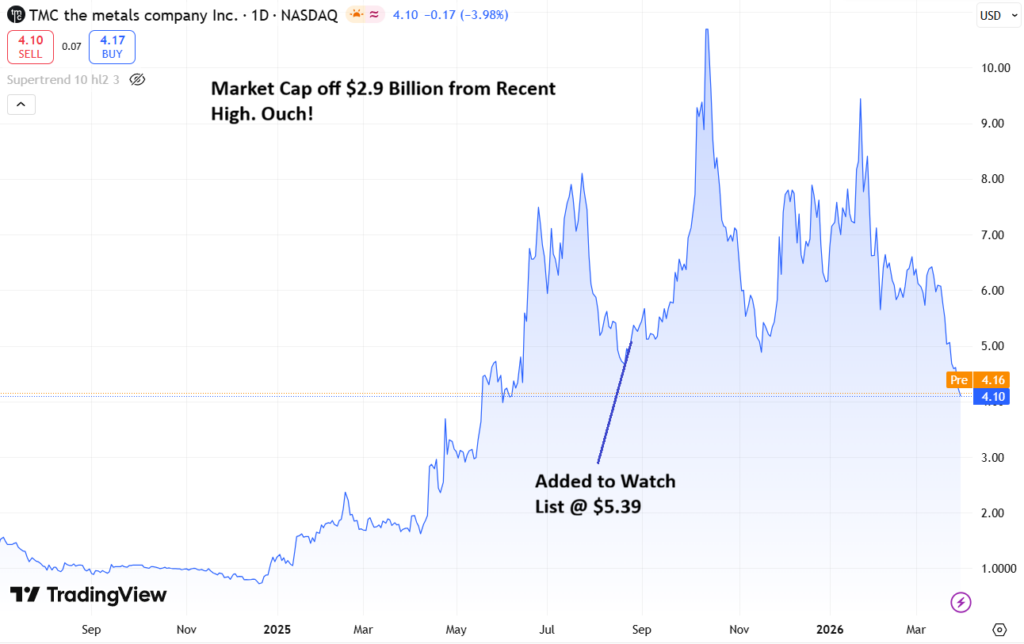
With 413 million shares outstanding, TMC has lost $2.9 billion in market value in the most recent rout!
Investors have to keep reminding themselves that a pre-feasibility study issued earlier this year assigned a net present value (NPV) of $5.5 billion to the company’s NORI-D project. When combined with other resources, the PFS and technical analyses indicate an overarching project value of $23.6 billion.
Deep-sea mining hopeful The Metals Company (Nasdaq: TMC) reported on Friday a wider annual loss for 2025 as it advances plans for a US-based polymetallic nodule processing hub and takes steps to strengthen its regulatory position.
TMC ended 2025 with $117.6 million in cash and a fourth-quarter net loss of $40.4 million, or $0.08 per share, compared with $16.1 million a year earlier, as higher share-based compensation and administrative costs weighed on results.
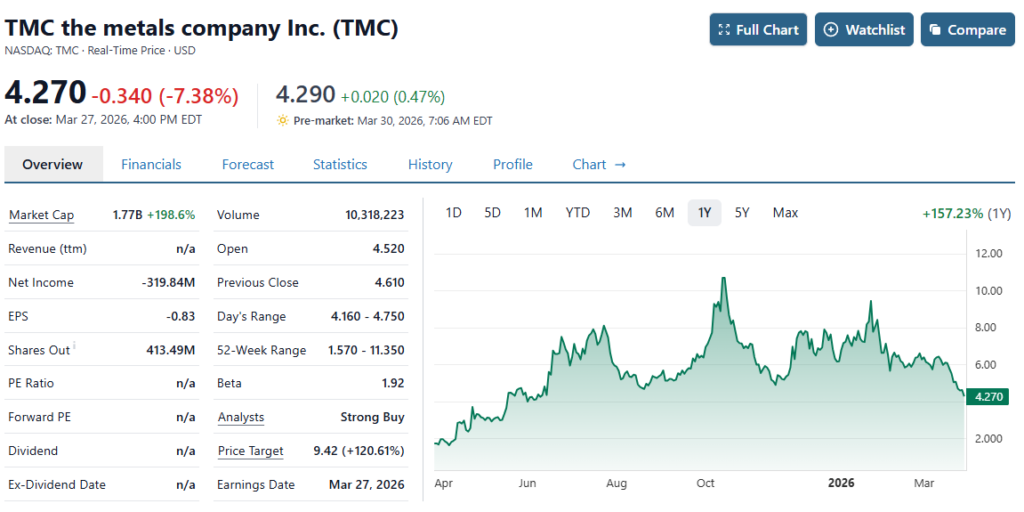
For the full year, net loss widened to $319.8 million, reflecting a $131 million increase in NORI royalty liability (tied to future revenue from its deep-sea mining project in the Pacific Ocean) and a $38 million non-recurring charge tied to revised sponsorship agreements.
“In my time leading TMC, I’ve never felt better about our pathway to production because of our financial, strategic, and permitting position,” CEO Gerard Barron said, citing stronger policy support in the US, new partners and progress on feasibility work. He added the company expects to maintain solid liquidity, with about $154 million projected by the end of the first quarter of 2026.
RELATED: TMC the metals company Inc. (TMC) Q4 2025 Earnings Call Transcript
Project’s economics
An independent report from Deep Sea Mining Canada, Greenpeace International and Mining Watch Canada said TMC is unlikely to generate profits in the near term. Dr. Steven H. Emerman, a consultant specializing in evaluating the environmental impacts of mining, said the company’s economic analysis does not align with SEC guidance, which requires assessments to be based on mineral reserves alone — the only economically mineable portion of a resource.
“By contrast, the economic analysis in The Metals Company’s prefeasibility study is based on 51 million wet metric tonnes of reserves plus an additional 113.1 million wet metric tonnes of resources,” Emerman said, adding that even when including resources, the project fails to meet the technical, financial and regulatory thresholds expected of a credible mining development.
TMC is positioning itself to anchor a US-based processing industry, securing exclusive negotiations for a 1,466-acre site at the Port of Brownsville, Texas, where it aims to develop a 12-million-tonne-per-year processing and refining facility. The project remains contingent on US government support, while the company continues to assess a capital-light tolling option in Japan.
The strategy comes as the US and its allies look to secure critical mineral supply chains and reduce reliance on foreign processing, particularly from China. A recent US-Japan agreement to accelerate the development of commercially viable deep-sea mining, along with updated NOAA regulations to streamline permitting, could support TMC’s path to production.
Full throttle
Operationally, TMC marked a key regulatory milestone this month after the National Oceanic and Atmospheric Administration (NOAA) deemed its consolidated deep-seabed mining application in substantial compliance. The decision advanced the company’s sought-after permit to explore and extract minerals from the Pacific Ocean floor.
The application expands the potential mining area in the Clarion Clipperton Zone to about 65,000 km², with an estimated 619 million tonnes of wet nodules and additional upside.
TMC is also partnering with Mariana Minerals, a software-based minerals project developer and operator, to advance feasibility work and integrate AI-driven process controls for its proposed Texas facility. The move reflects a push toward more capital-efficient, technology-enabled project development, the company said.
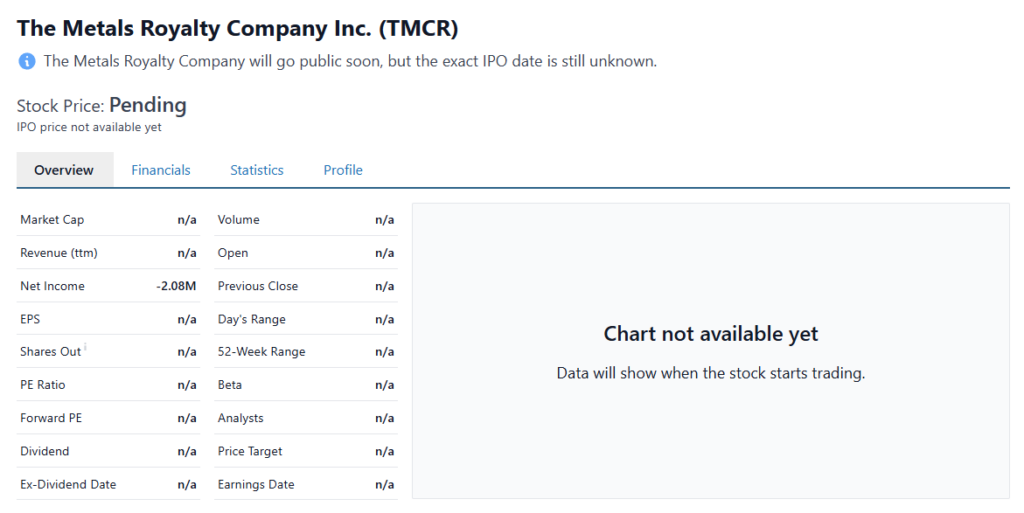
Looking ahead, TMC expects its newly created unit, The Metals Royalty Co. to begin trading next month under the ticker TMCR, with TMC retaining roughly a 25% stake and options to repurchase a significant portion of associated royalties over time.
IMPOSSIBLE METALS
Forward Looking Statements
This post contains “forward-looking” statements and information within the meaning of the Private Securities Litigation Reform Act of 1995. These statements may be identified by words such as “believes,” “could,” “expects,” “may,” “plans,” “possible,” “potential,” “will” and variations of these words or similar expressions, although not all forward-looking statements contain these words. Forward-looking statements in this press release include, but are not limited to, statements with respect to the Company’s strategy to pursue commercial recovery of seafloor polymetallic nodules under the U.S. regulatory regime; the outcome and timing of regulatory reviews of its applications submitted pursuant to the Deep Seabed Hard Mineral Resources Act of 1980 (DSHMRA); the progression of the Company’s applications through NOAA’s certification process and expected review timelines; the expected use of proceeds from the Company’s 2025 financings and other capital sources; the timing and success of environmental assessments, feasibility studies, technical and processing trials; the potential economic outcomes described in the Company’s Pre-Feasibility Study and Initial Assessment; the belief that our cash balance will be sufficient to meet our working capital and capital expenditure commitments for at least the next twelve months from the date of this press release; the Company’s operational and financial plans, including the potential development of a commercial-scale offshore nodule collection system and related onshore processing facilities; and the Company’s plans relating to downstream logistics, processing and refining, including site selection and development activities in Brownsville, Texas, and engagement with third-party partners. The Company may not actually achieve the plans, intentions or expectations disclosed in these forward-looking statements, and you should not place undue reliance on these forward-looking statements. Actual results or events could differ materially from the plans, intentions and expectations disclosed in these forward-looking statements as a result of various factors, including, among other things: the outcome and timing of regulatory reviews by NOAA under DSHMRA; the ability to obtain an exploitation contract from the ISA or permits from the U.S. government; risks related to the Company’s dual-path permitting strategy; changes in environmental, mining and other applicable laws and regulations; the timing and results of environmental assessments and technical studies; the development, testing and scaling of offshore collection systems; risks related to strategic partnerships and technology sharing; uncertainties relating to processing nodules at commercial scale; metals price volatility; the sufficiency of the Company’s cash and ability to secure additional financing on acceptable terms or at all; dependence on third parties, including Allseas Group S.A. and PAMCO. including the ability to successfully finalize, execute and perform under definitive agreements with such parties on expected terms or at all; the outcome of any pending or future litigation; and other risks and uncertainties described in greater detail in the section entitled “Risk Factors” in the Company’s Annual Report on Form 10-K for the year ended December 31, 2024, filed with the U.S. Securities and Exchange Commission (SEC) on March 27, 2025, and in subsequent Quarterly Reports on Form 10-Q and Current Reports on Form 8-K filed with the SEC, including the Company’s Quarterly Reports on Form 10-Q for the quarter ended March 31, 2025 filed on May 14, 2025, and for the quarter ended June 30, 2025 filed on August 14, 2025. Any forward-looking statements contained in this press release speak only as of the date hereof, and the Company expressly disclaims any obligation to update any forward-looking statements contained herein, whether because of any new information, future events, changed circumstances or otherwise, except as otherwise required by law.