
Okay, This is Where it Gets Fun!
Pre-disclaimer! As we mentioned in Report II, “While we don’t internally issue revenue or earnings guidance, or price targets, we do however read and share those of others – when from established and reputable firms – which have analysts who do make forecasts.”
In this report we look at where valuations could go, using simple sector-standard price-to-sales ratios. Ratios are not opinions, they are ‘..if XX revenues are achieved and it sells for XX times sales it, the stock price will = XX.’
Is it factual? Yes. Is it realistic? That all depends on the numbers that are achieved. One thing we have been able to hang our hat on over the last 53 years, is Wall Street will reward the achievers and punish the non-achievers. Finding the achievers is the hard part, which up to investors.
(For example if a company achieves sales of $10 million and Wall Street values that at 5x sales, the market cap would be $50 million.)
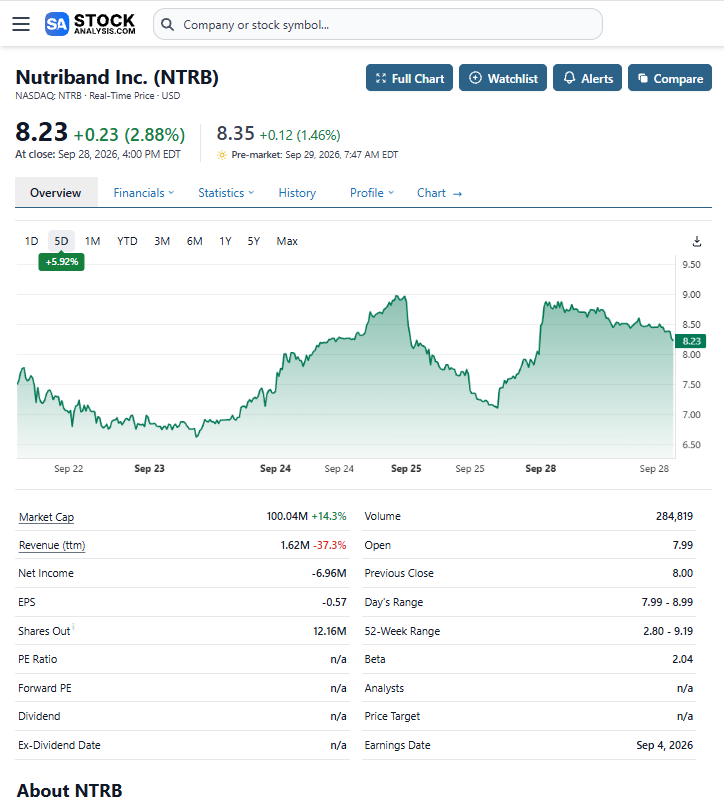
As we are long-term by nature, we don’t search for catalysts that could move the share price from $8 to $12, as worthy as a goal that may be for some. We are though cognizant of the potential effect of Nutriband announcing the initiation of their upcoming “HAL trial.” In short we think it’s wise for investors to be involved before news of that hits the tape, rather than after. But that said, we are looking out 2-3 years post-approval, for maximum potential valuation
So in a sense, it doesn’t matter if Nutriband is $6 or $12 in the next few months. We’re interested where it can be post approval (if approved), post initial sales launch, and post platform expansion (meaning other drugs that the Avensa patch can deliver).
Remember, we are NOT dealing with a new drug. We NOT even dealing with a new drug delivery method (transdermal patch). What we are dealing with is an widely accepted and proven drug delivery method (transdermal patch), that’s existed for decades (since 1979), that is being improved and enhanced.
1979: Scopolamine patch (for motion sickness)
1981: Nitroglycerin patch (for angina/chest pain)
1984: Clonidine patch (for high blood pressure)
1990: Duragesic / Fentanyl patch (for severe chronic pain)
1991: Nicotine patch (for smoking cessation) [1, 2, 3]
BASIC MATH – REVENUE ESTIMATES
- As we explained earlier with revenue estimates or forecasts, we prefer to stick with the “basic math,” which is to look at the Total Addressable Market or TAM of the subject company.
The basic math behind TAM’s, is multiplying number of potential prescriptions x cost of treatment. Basic as it gets. So if a treatment currently on the market is prescribed 10 million times a year, at a cost of $10 per prescription, we have a TAM of $100 million dollars. Total means total. It doesn’t account for the % of market share, which starts at 0% (no consumer acceptance) and can continue to 100%, or complete or total market dominance.
Also as we mentioned before – the most favorable dynamic we are dealing with Nutriband is that we factually know how many Fentanyl prescriptions are being made each year, because it is a wildly popular FDA approved drug.
Compare that to a ‘just approved’ drug to treat pain, which has never been sold before and then multiplying # of patients who have pain, x cost of treatment, to come up with a TAM. In such cases we don’t know how many Doctors will prescribe a just approved treatment for the first time, and we don’t know how many patients will find its performance sufficient, to request repeat treatments. We call that “voodoo math”
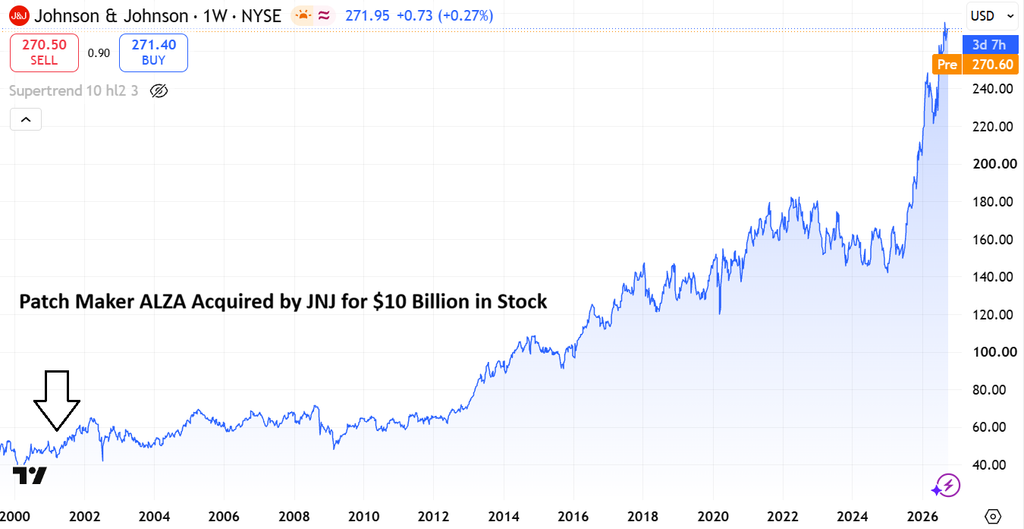
It doesn’t mean billions can’t be made by investors who embrace voodoo math. The first Fentanyl patch Duragesic, reached peak sales which exceeded $2.4 billion in 2004 (in one year) up from $0 in sales (in one year) in August of 1990, the year the patch was first approved. The Duragesic patch was invented by Alza Pharmaceutical (old symbol: ALZA).
The Fentanyl used was invented by Janssen Pharmaceuticals. Alza was acquired by Johnson & Johnson (JNJ) for $10.5 billion in stock (not bad for a company that ‘just’ made a patch) in June of 2001, and during a volatile (aka horrible) time in the market. JNJ has owned Janssen since 1961. The value that accrued to Alza shareholders, who kept their JNJ shares (and reinvested dividends) grew to a recent value of $257.2 billion (not a misprint). Even though 2001 was a horrible market, JNJ paid 10.6x sales which seem wildly overpriced at the time. But the JNJ guys apparently knew better.
(History: Because Alza specialized strictly in the delivery technology rather than synthesizing new chemical molecules, they needed a potent drug to test on their new transdermal skin patch design. They approached J&J’s Janssen unit because Fentanyl was highly lipid-soluble, making it the perfect candidate to pass through a patient’s skin. It was just a theory at the time, that worked out quite well.)
$257 billion is equal to roughly 40% of Johnson & Johnson’s entire corporate value today of $652 billion. Yes transdermal patches is a very good business. A $100,000 investment in Alza Corp., on the day the acquisition closed would be worth approximately $2,450,000 in JNJ stock today, assuming all Johnson & Johnson (JNJ) dividends were automatically reinvested. As well as assuming the shareholder didn’t sell.
A 10x P/S multiple is incredibly high for a pharmaceutical firm, but J&J paid a premium because Alza held the proprietary timed-release delivery technology (like the osmotic OROS system used in Concerta). J&J was already co-marketing Concerta and pocketing massive royalties from Alza’s fentanyl Duragesic patch. Buying Alza allowed J&J to stop paying those royalties, capture 100% of the drug revenues, and deploy Alza’s tech across its entire global drug pipeline.
This why investors should closely study Nutriband’s Aversa ‘platform’ over just simply it’s use with Fentanyl. Don’t think of Nutriband as a Fentanyl patch maker, think of it as a transdermal patch delivery platform for any drug which can be abused. We offer a list below.
BASIC MATH – PRICE TARGETS
Similar to revenue estimates or forecasts, we prefer to stick with the “basic math” when outlining Potential Price Targets (PPT).
The basic math behind PPT’s (in the pharmaceutical sector), is a multiple of sales, commonly know as Price-to-Sales ratio (PS). Similar to Price-to-Earnings, PS is the preferred metric, because sales can grow so fast and because of unusually high profit margins in the sector. Once past the FDA approval stage that is, because before approval there are no sales and of course then, no earnings. Or margins.
P/S is as basic a metric as it gets. You don’t even need a calculator. The number is usually in the single digits. Notable exceptions being Palantir which sells for 101x sales and Eli Lilly at 15x sales powered by GLP-1’s.
Note also, because of patient demographics – the total addressable market metric holds a larger importance than in other industries or sectors. That’s because the ‘purchase’ decision often isn’t optional. Deciding to buy the latest computer with 32GB of ram, regardless of how many computer users there exists in the world, will always be optional. So the TAM could be meaningless.
Deciding whether to take a statin prescribed by your physician for high blood pressure for example, when you have high blood pressure – not so optional. And the medical community has a fairly good handle on how many people have high blood pressure both in the U.S. world-wide at any point in time. So the # of people who have high blood pressure x the cost of treatment, holds much more TAM weight.
Ditto with people in pain and Fentanyl. There is a lot of bad press about Fentanyl, but for people is chronic pain, it is a truly a Godsend life saver and not optional.
What can go wrong? Well besides everything, most importantly the sales estimates could be totally wrong, which are the first part of the formula. # of prescriptions X $ cost of prescription. That is what it is, in the Pharma sector. There is no knowing for sure. Approval does not = sales. Though approval can mean massive sales.
A Deeper Dive into NutriBand’s (NTRB) Price Targets
The Preface: Sailing with Wall Street Pirates
Another Disclaimer: Note that the numbers below represent what can be defined as “best-case, wildly optimistic scenarios.” Could we list a safe, ultra-conservative “most likely” model? Sure. But even those would just be guesses.
Let’s be real: this ship is run by Wall Street pirates. The market is far more interested in the absolute best thing that can happen versus the average outcome. We are modeling the total explosive potential of a platform monopoly. If you want to know how big the treasure chest gets if or when everything goes right, read on.
The Multi-Pipeline Evolution
NutriBand is officially shedding its skin as a single-asset Fentanyl story. By layering in official validation from the Health Advances market assessment for Buprenorphine alongside the massive macro tailwinds of the $10B U.S. ADHD market (including Methylphenidate), the AVERSA platform has the potential to transform into a diversified drug-delivery powerhouse.
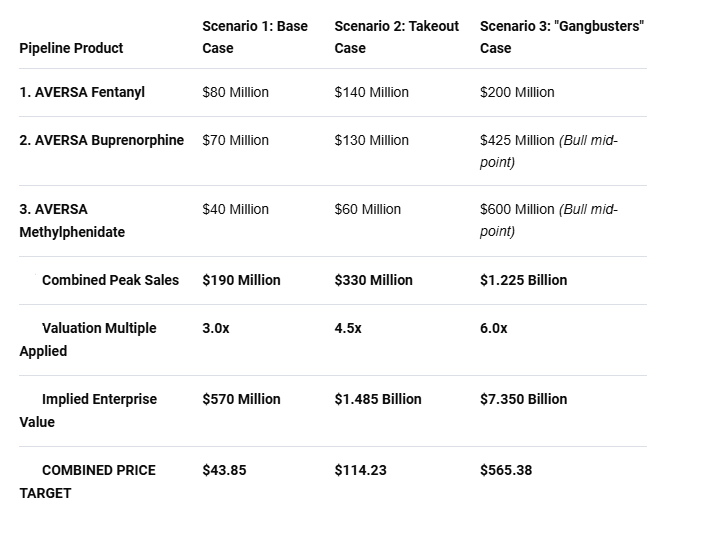
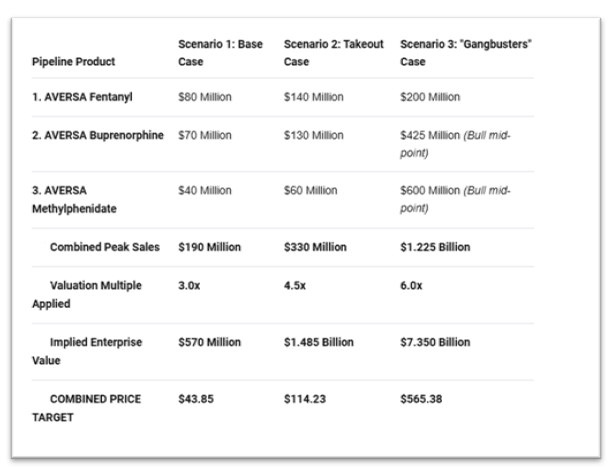
By evaluating the portfolio on a conservative 13.0 million fully diluted share count (accounting for potential near-term warrant conversions), we have mapped out three multi-line revenue tracks, Note we display a P/S ratio of 3-6x whereas ALZA was again acquired for 10x:
Sum-of-the-Parts (SOTP) Valuation Model
The Origins of Fentanyl
- Synthesis: Dr. Paul Janssen synthesized fentanyl in 1960 at Janssen Pharmaceutica.
- Potency: It was designed to be a synthetic opioid roughly 100 times stronger than morphine and highly fat-soluble for rapid medical action.
- Early Use: In the 1960s, it was introduced primarily as an intravenous anesthetic (known as Sublimaze) for surgeries.
Creating the Transdermal Patch
- The Need: Traditional oral or frequent injectable opioids caused major peaks and valleys in pain control and blood levels, making it hard for patients with chronic, round-the-clock pain (such as advanced cancer) to find stable relief.
- The Technology: In the 1980s and 1990s, companies like Alza Corporation partnered with Johnson & Johnson to engineer a skin patch (Duragesic) that could slowly and consistently diffuse fentanyl through the skin and into the bloodstream.
- Approval & Success: Released in the mid-1990s, Duragesic allowed a single patch to release steady medication for 72 hours, revolutionizing palliative and chronic pain care, eventually reaching over $2 billion in peak sales by 2004.
Safety and Risks
Dangers: Misusing the patch (such as cutting, chewing, heating, or exposing it to high fevers) can cause a massive, fatal overdose of Fentanyl into the body. Because of these severe risks, the FDA issued multiple safety warnings in the 2000s and restricted its use strictly to opioid-tolerant patients.
Top 5 Substitutes If Fentanyl Were Banned
We are often asked from friends what is the worst case, wild card. Our answer is Fentanyl gets banned. Remember Quaaludes? We do, as they were quite popular (disco biscuits) in our college days at UCLA in the 70’s. Quaaludes were politically banned in the United States in 1984 because an epidemic of recreational abuse, severe addiction, and fatal overdoses made the drug a primary target of the federal government’s expanding “War on Drugs”.
Political leaders faced intense pressure to act due to surging numbers of emergency room visits, severe psychological addiction, and fatal car accidents caused by people driving under the influence of the drug. From what we’ve seen on YouTube, we don’t have to worry much about people on Fentanyl driving cars. They have a hard time getting in a car.
If however a catastrophic regulatory event did force a total ban on fentanyl, the transdermal patch market and operating rooms would immediately pivot to these top five clinical substitutes: Which to us means more opportunity for Nutriband as they too could immediately pivot.
1. Hydromorphone (Dilaudid)
- The Role: The most seamless immediate replacement for severe pain.
- Why it works: It is roughly 5 to 7 times more potent than morphine and behaves very similarly to fentanyl in a hospital setting. It causes less nausea and fewer allergic reactions than standard morphine, making it the immediate go-to choice for severe post-surgical pain.
2. Buprenorphine (Butrans / Belbuca)
- The Role: The direct replacement for the Transdermal Patch market (the Alza/Kindeva footprint).
- Why it works: Buprenorphine is already highly successful in a 7-day transdermal patch form (Butrans). Because it is a partial opioid agonist, it has a “ceiling effect” on respiratory depression, making it drastically safer and less likely to cause a fatal overdose than fentanyl. If fentanyl patches disappeared, buprenorphine patches would instantly swallow the chronic pain market.
3. Sufentanil & Alfentanil
- The Role: The Operating Room replacements.
- Why it works: These are direct chemical cousins to fentanyl, but they are technically distinct molecules. Sufentanil is actually 5 to 10 times more potent than fentanyl itself. They are used exclusively by anesthesiologists in operating rooms for major surgeries because they share fentanyl’s unique trait of keeping a patient’s heart and blood pressure incredibly stable under stress.
4. Remifentanil
- The Role: The Short-Term Sedation replacement.
- Why it works: This cousin molecule possesses a magnificent chemical quirk: it is rapidly broken down by common enzymes in human blood rather than relying on the liver or kidneys. It wears off completely within minutes of turning off an IV drip, making it the ultimate tool for outpatient surgeries where doctors need a patient awake and moving immediately after a procedure.
5. Morphine
- The Role: The Traditional Fallback.
- Why it works: The old faithful of medicine. While it takes longer to kick in and can cause blood pressure to drop significantly compared to fentanyl, it remains cheap, widely manufactured, and universally understood by every healthcare provider on earth.
Why This Helps the Nutriband/Kindeva Case
The fact that fentanyl is too vital to ban is exactly why an abuse-deterrent technology like AVERSA is so commercially viable. Because the government cannot legally ban the underlying molecule without crippling American hospitals, their only alternative is to mandate or heavily incentivize physical security upgrades to the patch itself.
Nutriband Modern Fentanyl Patch Ecosystem
- The Molecule Provider (Fentanyl): Kindeva sources the raw active pharmaceutical ingredient (API) from specialized, heavily regulated global chemical manufacturers (such as Mallinckrodt or Johnson Matthey).
- The Device / Patch Maker: Kindeva Drug Delivery. They own the FDA-approved generic fentanyl patch technology. They provide the matrix engineering, structural adhesive, and manufacturing facilities (like their large-scale plant in Northridge, CA).
- The Patch Enhancement: Nutriband Inc. They own a proprietary technology called AVERSA™. This is an abuse-deterrent layer containing “aversive agents” (like bitterants or skin irritants) baked into the patch. If someone tries to chew, boil, or crush the patch to abuse the fentanyl, the aversive agent activates to prevent misuse.
Where Do All Generic Patch Makers Get Their Fentanyl?
Because fentanyl is a Schedule II controlled substance, generic patch makers (like Sandoz, Mylan/Viatris, Apotex, or Aveva/DifGen) cannot just buy it on the open market. They get it through a tightly locked supply chain:
- The Specialized API Manufacturers: Companies like Mallinckrodt Pharmaceuticals (the largest US manufacturer of generic opioids), Johnson Matthey, and Purisys are the actual chemical factories that synthesize raw bulk fentanyl powder.
- DEA Quota Allocations: Every single year, the Drug Enforcement Administration (DEA) establishes an Aggregate Production Quota (APQ) for fentanyl. The DEA dictates the exact number of grams a company like Kindeva or Mylan is allowed to purchase and process to ensure there is no excess supply flowing into the market.
Summary: In the new process, Kindeva manufactures the patch, Nutriband overlays its AVERSA abuse-deterrent technology, and the raw fentanyl chemical is supplied to the factories by DEA-cleared bulk opioid manufacturers.
Why Patients Need a Buprenorphine Patch
Buprenorphine is a highly effective, long-acting partial opioid agonist used for managing chronic pain. A transdermal patch offers unique advantages over oral opioids:
- 7-Day Steady Pain Relief: Unlike oral pills that must be taken multiple times a day, a buprenorphine patch (like the brand Butrans) delivers continuous, steady pain relief for 7 full days from a single application.
- Ceiling Effect on Respiratory Depression: Compared to full opioids like oxycodone or morphine, buprenorphine has a built-in safety “ceiling effect”. This makes it much less likely to cause a fatal overdose, making it a preferred choice for long-term chronic pain management.
- High Abuse Risk Without Deterrents: Because buprenorphine is still an opioid, existing patches are frequently targeted for abuse. Individuals chew them or chemically extract the drug to bypass the slow-release matrix. An AVERSA version solves this by contaminating the drug if the patch is tampered with.
Buprenorphine is sold under several trade names depending on its medical use and delivery method, including Suboxone, Subutex, and Butrans. Common Trade Names and Uses. - Opioid Use Disorder (Addiction Treatment):
• Suboxone: Combination of buprenorphine and naloxone (sublingual film or tablet).
• Subutex: Pure buprenorphine sublingual tablet (mostly discontinued, generics available).
• Sublocade & Brixadi: Extended-release subcutaneous injections.
• Zubsolv: Sublingual tablet formulation of buprenorphine/naloxone. - Pain Management:
• Butrans: Transdermal skin patch for chronic, severe pain.
• Belbuca: Buccal film (dissolves inside the cheek) for chronic pain.
• Buprenex: Injectable solution used for acute pain
Historical Context: How Much Does Buprenorphine Sell?
The benchmark for this market is Butrans (the pioneer 7-day buprenorphine patch) and its subsequent generics:
- U.S. Market Baseline: Prior to heavy generic erosion, U.S. annual sales for Butrans hovered around $225 million.
- Global Patch Market: The broader buprenorphine transdermal patch market has shown robust growth as doctors actively shift patients away from traditional oral opioids.
The Wildly Optimistic Sales Potential for AVERSA Buprenorphine
The firm projected that if approved by the FDA, a competitively priced AVERSA Buprenorphine patch could comfortably reach peak annual U.S. sales of $70 million to $130 million under standard market conditions. However, a “wildly optimistic” bull-case scenario factors in stricter government intervention and regulatory mandate.
Nutriband commissioned healthcare consulting firm Health Advances to run a formal market assessment for AVERSA Buprenorphine (standard/company).
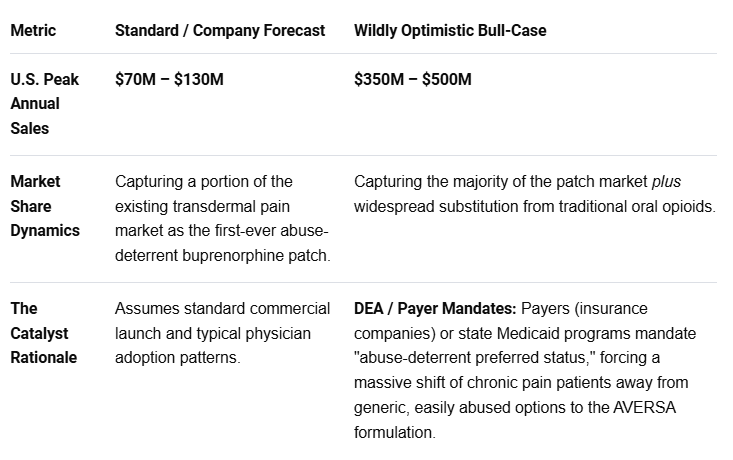
Nutriband’s Aversa™ Buprenoprhine May Reach Peak Annual Sales of $70-130 Million
Why Patients Need a Methylphenidate Patch
Methylphenidate is sold under common brand names including Ritalin and Concerta.
Common Trade Names and Uses
- Ritalin: An immediate-release oral tablet.
- Concerta: An extended-release oral tablet.
- Methylin: A liquid or immediate-release tablet.
- Metadate: An extended-release capsule or tablet.
- Quillivant XR: An extended-release liquid suspension. [1, 2, 3, 4, 5]
Uses
- Treating attention-deficit/hyperactivity disorder (ADHD).
- Managing symptoms of narcolepsy.
The business plan behind AVERSA Methylphenidate centers on a classic pharmaceutical “platform technology” licensing and risk-reduction model. Developed by Nutriband Inc., the strategy is not to reinvent the drug itself, but rather to wrap existing medications in a proprietary, patent-protected abuse-deterrent shell.
The primary business rationale breaks down as follows:
- Targeting the Only “Patch” on the ADHD Market
Methylphenidate is widely prescribed, but AVERSA is specifically targeting the transdermal (skin patch) market. Currently, the primary methylphenidate patch on the market is Daytrana. While highly effective, transdermal stimulant patches carry a unique risk: individuals can attempt to scrape, chemically extract, or chew the medication matrix out of the patch to get a massive, immediate dose of the stimulant. - The “Aversive Layer” Technology
The AVERSA business model relies on a proprietary technology that embeds “aversive agents” (like bitter substances or skin/taste irritants) into an isolated layer of the patch.
- Normal use: The patient wears the patch, and the methylphenidate absorbs cleanly through the skin. The aversive agent never touches the skin or the drug.
- Abuse or misuse: If someone attempts to crush, chew, or chemically extract the drug, the aversive layer breaks, contaminating the drug and rendering it unusable or highly unpleasant.
- The 505(b)(2) Regulatory Shortcut
From a financial perspective, Nutriband is utilizing the FDA’s 505(b)(2) regulatory pathway. Instead of spending billions of dollars and a decade proving that methylphenidate works to treat ADHD, they rely on the safety data of existing drugs. They only have to prove that their abuse-deterrent patch safely delivers the medicine and effectively stops tampering. This drastically cuts research and development costs and fast-tracks the timeline to commercialization. - A Portfolio and Licensing Play
The overarching business plan is a “Follow the Leader” sequence:
- Phase 1 (Current Focus): Nutriband is focusing almost all its immediate cash and clinical trial efforts on AVERSA Fentanyl. Because fentanyl is an opioid with massive public health urgency, it serves as the proof-of-concept to get FDA approval and validation from a manufacturing partner (they currently partner with Kindeva Drug Delivery to scale production).
- Phase 2 (The Pipeline): Once AVERSA Fentanyl establishes the commercial blueprint, Nutriband intends to copy-and-paste that exact manufacturing process onto AVERSA Methylphenidate and AVERSA Buprenorphine.
By doing this, they create a defensive wall of global patents that makes them an attractive target for a larger pharmaceutical acquisition, or allows them to license the patch technology to generic drug manufacturers looking to charge a premium for an “abuse-deterrent” label.
The Positives: Why Patients Need a Methylphenidate Patch
The transdermal patch offers unique clinical advantages over oral ADHD medications:
- Customizable, Flexible Dosing Duration: Unlike a long-acting pill (like Concerta) which remains active in the body for 10–12 hours once swallowed, a patch can simply be peeled off early. If a child needs to eat a normal dinner or fall asleep early, a parent can remove the patch after 6 or 9 hours to halt active medication delivery.
- Bypasses the Digestive System: Transdermal absorption sends the medicine directly into the bloodstream through the skin, minimizing standard gastrointestinal side effects like stomachaches or nausea.
- No Pill-Swallowing Requirement: A significant percentage of pediatric ADHD patients struggle to swallow large capsules or extended-release pills.
- Steady Blood Levels: The patch acts as a slow-release reservoir, preventing the “peaks and valleys” (sudden bursts of focus followed by severe crashes) common with oral medication.
Historical Context: How Much Does Daytrana Sell?
Daytrana (the pioneer methylphenidate patch) had a volatile commercial lifecycle. - Peak Revenue: Shortly after its launch, Daytrana brought in roughly $60 million to $80 million annually for Shire Pharmaceuticals.
- The Decline: Manufacturing issues—specifically patches getting stuck to their plastic backing liners—triggered several voluntary market recalls. This severely hurt doctor and consumer confidence.
- Recent Sales: According to IQVIA data, annual market sales for Daytrana fell to approximately $43 million.
- Current Status: In early 2026, Noven Pharmaceuticals officially discontinued the branded Daytrana patch, leaving the methylphenidate patch market open for a safer, modern alternative.
Deconstructing the Wall Street Projections: Robert LeBoyer, MBA
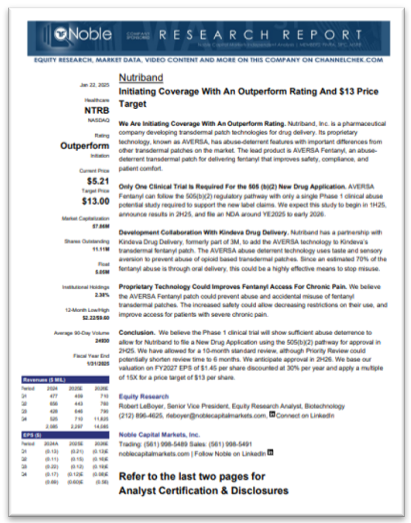
The steep product revenue ramp that lands at $177 Million by 2028E was officially modeled by Robert LeBoyer, Managing Director and Senior Biotechnology Analyst at Noble Capital Markets. While LeBoyer’s public tracking metrics are typical of the volatile, high-risk micro-cap biotech sector, his institutional pedigree is undeniable.
- The Pedigree: LeBoyer is a FINRA-licensed industry veteran who holds a BA in Economics from Tulane University and an MBA from Columbia Business School.
- The Experience: Before joining Noble Capital Markets, he cut his teeth in senior equity research roles at premier medical institutions including Leerink Swann (now SVB Securities), Brown Brothers Harriman, and Ladenburg Thalmann.
- Direct Access: Rather than taking our word for his forecasts, institutional readers can directly verify, download, and track the full framework in the Official Noble Capital Markets NTRB Research Report published via Channelchek. You may have to sign in, it’s free.
Initiating Coverage With An Outperform Rating And $13 Price Target
The Heavyweights: Health Advances, LLC
What makes the broker-dealer model compelling is how closely it aligns with the proprietary baseline study executed by Health Advances, which maps out a conservative-to-optimistic AVERSA™ Fentanyl peak target of $80 Million to $200 Million. Health Advances is not a promotional small-cap marketing outfit; they are an elite healthcare strategy consultancy built on high-level operational excellence:
- Bain & Company DNA: Health Advances was founded over 30 years ago by senior consultants who spun out from Bain & Company, instilling strict top-tier management consulting analytics exclusively into the life sciences sector.
- The Parexel Engine: In 2016, the firm was absorbed by Parexel International, a dominant global Clinical Research Organization (CRO) with 22,000+ employees managing clinical trial networks for the world’s largest multi-national pharmaceutical corporations.
- The Brain Trust: Their elite analyst roster consists almost entirely of MDs, PhDs, and molecular biologists who bridge complex clinical realities with economic Wall Street models.
More to come..
About Nutriband Inc.
Nutriband is primarily engaged in the development of a portfolio of transdermal pharmaceutical products. Our lead product under development is an abuse-deterrent fentanyl patch incorporating our AVERSA™ ™ abuse-deterrent technology. AVERSA™ ™ technology can be incorporated into any transdermal patch to prevent the abuse, misuse, diversion, and accidental exposure of drugs with abuse potential.
The Company’s website is www.nutriband.com. Any material contained in or derived from the Company’s websites or any other website is not part of this report.
Forward-Looking Statements
Certain statements contained in this report, including, without limitation, statements containing the words ‘’believes,” “anticipates,” “expects” and words of similar import, constitute “forward-looking statements” within the meaning of the Private Securities Litigation Reform Act of 1995. Such forward-looking statements involve both known and unknown risks and uncertainties. The Company’s actual results may differ materially from those anticipated in its forward-looking statements as a result of a number of factors, including those including the Company’s ability to develop its proposed abuse-deterrent fentanyl transdermal system and other proposed products, its ability to obtain patent protection for its abuse technology, its ability to obtain the necessary financing to develop products and conduct the necessary clinical testing, its ability to obtain Federal Food and Drug Administration approval to market any product it may develop in the United States and to obtain any other regulatory approval necessary to market any product in other countries, including countries in Europe, its ability to market any product it may develop, its ability to create, sustain, manage or forecast its growth; its ability to attract and retain key personnel; changes in the Company’s business strategy or development plans; competition; business disruptions; adverse publicity and international, national and local general economic and market conditions and risks generally associated with an undercapitalized developing company, as well as the risks contained under “Risk Factors” and “Management’s Discussion and Analysis of Financial Condition and Results of Operations” in the Company’s Form S-1, Forms 10-K and Forms 10-Q, and the Company’s other filings with the Securities and Exchange Commission. Except as required by applicable law, we undertake no obligation to revise or update any forward-looking statements to reflect any event or circumstance that may arise after the date hereof.
RESOURCES: ScienceDirect, The Fentanyl Story.