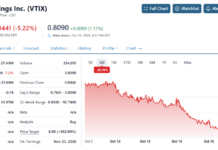

Some confusion in the market about a recent NASDAQ Notice. We’ll let AI (below) attempt to clear it up. And even though this is no action until March 29, 2027 – it is not your NASDAQ to OTC type notification. The wording in the 8K, was what was unclear.
AI EXPLANATION
Q: Listing Requirement. This doesn’t mean delisted to OTC, right?
No, receiving this notice does not mean Virtuix Holdings Inc. (VTIX) has been delisted or moved to the Over-The-Counter (OTC) market.
1. What the Notice Actually Means
- Immediate Impact: Zero. As explicitly stated in the filing, the notice has no immediate effect on the listing or trading of VTIX Class A common stock. It continues to trade as normal on Nasdaq under the ticker symbol “VTIX.”
- The Compliance Clock: Nasdaq gives companies a 180-calendar-day grace period (until March 29, 2027) to regain compliance.
- How to Regain Compliance: The company’s Market Value of Listed Securities (MVLS) simply needs to close at $50,000,000 or more for 10 consecutive business days at any point before March 29, 2027.
- If They Don’t Reach $50M by March 29, 2027:
- They can request an appeal before a Nasdaq Hearings Panel (which halts delisting during the appeal).
- Or, they can transfer to The Nasdaq Capital Market (detailed below), which keeps them on a major, top-tier national exchange while carrying a much lower market value threshold.
2. Practical Difference: Nasdaq Global Market vs. Nasdaq Capital Market
Both tiers are official, fully regulated tiers of The Nasdaq Stock Market LLC. Neither is the OTC market. For everyday retail or institutional investors, shares trade, settle, and clear in the exact same manner under the ticker VTIX.
The main practical differences lie in listing standards, corporate prestige, and institutional perception:
| Feature / Standard | The Nasdaq Global Market | The Nasdaq Capital Market |
| Market Tier Level | Mid-tier / Upper-tier | Standard / Entry-level tier |
| Continued MVLS Requirement | $50,000,000 | $35,000,000 (or alternative total asset/equity standards) |
| Institutional Perception | Higher visibility; preferred by mid-cap and large-cap institutional funds whose mandates restrict micro-caps. | Viewed as the “growth” or small-cap tier; commonly used by early-stage, direct-listing, or micro-cap companies. |
| Prestige / Mindshare | Positioned directly below the Nasdaq Global Select Market (home to mega-caps like Apple, Meta, Microsoft). | Designed specifically for emerging growth companies raising capital or maintaining public listings. |
| Trading Mechanics | Same exchange, order execution, and clearing systems. | Same exchange, order execution, and clearing systems. |
Key Takeaway for VTIX
If Virtuix’s stock price and market capitalization remain under the $50M mark through March 2027, transferring to the Nasdaq Capital Market is a standard corporate maneuver. It allows the company to remain listed on Nasdaq, retain its “VTIX” symbol, and completely avoid dropping down to the OTC markets.
Q: And what pray tell happen if it stays below $35 million next year?
If Virtuix’s Market Value of Listed Securities (MVLS) drops below $35,000,000, here is what happens step-by-step:
1. Transfer to the Nasdaq Capital Market
If Virtuix cannot meet the $50M MVLS requirement on the Nasdaq Global Market, its immediate play to remain on a top-tier national exchange is applying for a transfer to the Nasdaq Capital Market.
- The $35M MVLS Standard: The Nasdaq Capital Market requires a minimum MVLS of $35,000,000 under Nasdaq Listing Rule 5550(b)(2).
- Alternative Standards: If the market cap dips below $35M, a company can still maintain its Nasdaq listing if it meets one of two alternative standards:
- Stockholders’ Equity Standard: Minimum stockholders’ equity of $2,500,000.
- Net Income Standard: Net income from continuing operations of at least $500,000 in the most recently completed fiscal year or in two of the last three fiscal years.
2. What Happens If It Drops Below $35M (and Fails the Equity/Net Income Alternatives)?
If the company fails all standards for the Capital Market tier, Nasdaq will issue a Delisting Determination Letter. However, this still does not mean an instant drop to OTC trading on the next day.
The company then enters the official Nasdaq appeal and grace period sequence:
- Hearing Request (Halts Delisting): Within 7 calendar days of receiving the determination letter, Virtuix can request a hearing before an independent Nasdaq Hearings Panel. Requesting this hearing automatically stays (pauses) the delisting and keeps the stock trading on Nasdaq until the panel renders a final decision.
- The Panel Plan: At the hearing, Virtuix can present a strategic compliance plan (e.g., executing an equity/debt financing round, acquiring assets, or outlining operational catalysts to restore market capitalization). The panel has the authority to grant an additional extension of up to 180 calendar days from the date of the delisting letter to regain compliance.
3. The Last Resort: Delisting to OTC
If all compliance periods, transfers, and hearing panel extensions expire without the company restoring its market value or meeting the alternative equity thresholds, Nasdaq will issue a final suspension notice.
At that final point:
- The stock will be suspended from trading on Nasdaq.
- Market makers will migrate the shares to trade on the Over-The-Counter (OTC) Markets (such as the OTCQX, OTCQB, or Pink Sheets) under the symbol VTIX (or VTIXD/VTIXQ depending on conditions).
- The company remains a public reporting company subject to SEC filings (10-Ks, 10-Qs) as long as it maintains its public registration, but trading liquidity and institutional access may drop significantly on OTC tier venues.