Had a conversation over Mimosa’s Sunday morning with one of our AI Analyst on the tokenization of publicly traded companies, and some interesting information surfaced…
Tokenized Stocks Are Here to Stay
We think five years from now, we’ll look back at “market hours” the way we look back at dial-up internet — a quaint relic of infrastructure that simply couldn’t keep up. Tokenized stocks aren’t a fringe experiment anymore; they’re the plumbing upgrade Wall Street has been avoiding for decades because it never had to build it.
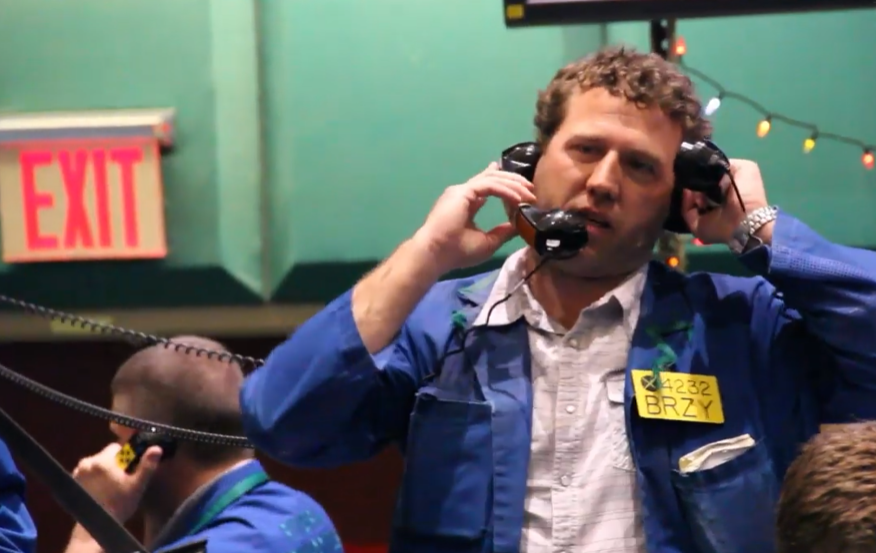
Once blue-chip names trade as tokens on-chain around the clock, the 9:30-to-4:00 window becomes a historical footnote, along with drinks at the close. A trader in Italy or Singapore won’t need a U.S. brokerage account, a wire transfer, and three days of patience to own a slice of Apple or GeoVax — all they’ll need a wallet when getting home at 1:00am after a Saturday evening out. That’s not a nice-to-have. That’s the entire addressable market of global retail investors (and gamblers) finally getting the door kicked open.
And here’s the part that makes it inevitable rather than just likely: liquidity follows access, and access follows convenience. Once one major exchange or broker proves out 24/7 settlement without blowing up the system, every competitor is forced to follow or get left holding yesterday’s model.
We’ll see fractional ownership go from a gimmick to the default, cross-border capital flow into U.S. equities explode, and a genuinely global order book that doesn’t sleep just because New York does. The companies and platforms that figure out the compliance and custody piece early aren’t just early adopters — they’re the ones who get to write the rules everyone else has to play by. That’s the story worth telling now, while it’s still a prediction and not old news.
THE TOKENIZATION OF SMALL-CAP PUBLIC COMPANIES
A Working Discussion on Securitize, tZERO, INX, Republic, and the Potential for Tokenized Dual Listings
SECURITIZE AND THE TOKENIZATION MARKET
Securitize went public on the New York Stock Exchange under the ticker SECZ on July 2, 2026, through a merger with the special purpose acquisition company (SPAC) Cantor Equity Partners II, rather than a traditional initial public offering. The deal valued the digital asset and real-world-asset tokenization platform at a $1.25 billion pre-money valuation and raised approximately $400 million.
Securitize, is the world’s leader in tokenizing real-world assets with $5B+ AUM (as of July 2026)
Transaction Details
Listing Date: July 2, 2026 (merger closed June 30)
Exchange / Ticker: NYSE: SECZ
Valuation: $1.25 billion pre-money equity value
Capital Raised: Approximately $400 million, which included an upsized $225 million PIPE financing
Key Backers & Partners: BlackRock, Morgan Stanley, ARK Invest, and Cantor Fitzgerald
Onchain Integration
Securitize issued tokenized versions of its own equity on Layer-1 networks Avalanche and Solana during its market debut.
The company subsequently partnered with Cantor Fitzgerald to create regulatory frameworks enabling other public companies to perform blockchain-based onchain IPOs and follow-on offerings.
HOW DOES ASSET TOKENIZATION WORKS ON THE SECURITIZE PLATFORM
The Securitize platform works by converting traditional financial products—like funds, equities, and real-world assets—into blockchain-based digital tokens.
Rather than operating as just a software provider, Securitize unifies a fully vertically integrated, regulated stack that legally handles everything from investor onboarding to secondary trading under SEC oversight.
A comprehensive breakdown reveals how this process operates step-by-step.
STEP 1: LEGAL STRUCTURING AND ASSET CUSTODY
Asset Continuity: The legal structure of the asset remains unchanged; the asset continues to exist off-chain.
Traditional Custody: Assets, such as the U.S. Treasuries powering BlackRock’s BUIDL fund, are stored securely with traditional, institutional custodians.
The Shift: The only aspect that shifts is how the ownership records are updated and maintained—moving from segregated legacy spreadsheets to an open, programmable ledger.
STEP 2: COMPLIANCE AND ONBOARDING — SECURITIZE iD
Identity Management: Prior to accessing any onchain offering, all investors must verify their identity through the identity system.
Automated Screening: The system executes identity screening (KYC), corporate screening (KYB), accreditation status validation, and geographic boundary filters.
Tailored Access: Compliance logic automatically displays different financial products based on user jurisdiction and eligibility.
STEP 3: TOKEN ISSUANCE AND SMART CONTRACT ENFORCEMENT
Minting Tokens: Securitize deploys specialized smart contracts onto public blockchains such as Ethereum, Avalanche, and Solana to mint the security tokens.
Programmed Regulations: The smart contract natively enforces regulatory rules directly onchain.
Compliance Checks: Every time a token is sent to a new wallet, the contract checks Securitize’s database to ensure both sender and receiver are whitelisted, qualified investors. If the target wallet is not cleared, the smart contract automatically blocks the transfer.
STEP 4: THE TRANSFER AGENT FUNCTION
The Legal Ledger: In traditional finance, a transfer agent maintains the definitive master ledger of who owns a company’s shares. Securitize operates as an SEC-registered Transfer Agent.
Blockchain as Registry: Instead of relying on a private, closed database, Securitize legally uses the blockchain itself as the official, legally binding master shareholder registry.
STEP 5: LIFECYCLE SERVICING AND SECONDARY-MARKET TRADING
Automated Payouts: Smart contracts govern ongoing corporate actions. For instance, dividend yields can be calculated daily and programmatically distributed directly into investor wallets at regular intervals.
Alternative Trading System (ATS): Investors do not have to wait days to exit positions. They can trade digital assets peer-to-peer on an instant-settlement timeline. Secondary-market trading is supported globally, operating around the clock without traditional market downtime.
Can you estimate SECZ related fees for as example a $100 million IPO?
ESTIMATED SECURITIZE-RELATED FEES FOR A $100 MILLION IPO
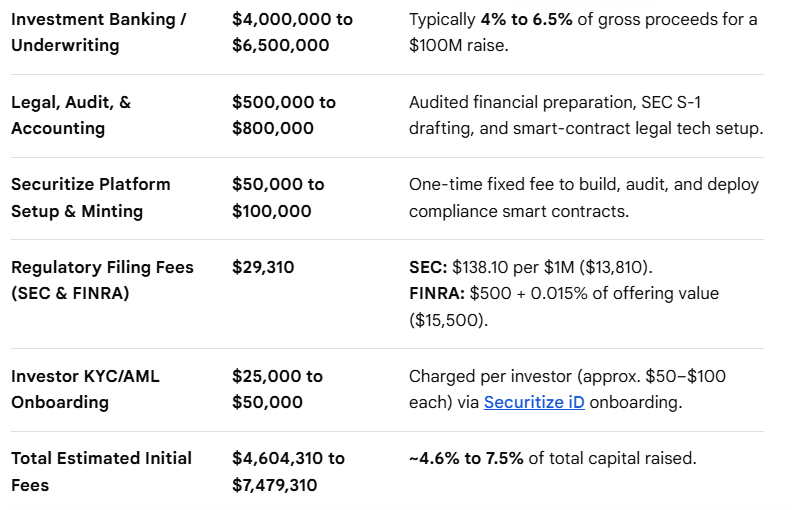
For a $100 million onchain IPO executed through the Securitize platform, in partnership with Cantor Fitzgerald, total estimated transaction fees range between $4.7 million and $7.5 million.
While tokenization and smart-contract execution drastically lower ongoing administrative costs, an onchain public listing must still satisfy traditional legal, underwriting, and regulatory framework expenses.
COST BREAKDOWN FOR A $100 MILLION ONCHAIN IPO
The table below breaks down the estimated initial costs based on standard public market fees and Securitize’s commercial tokenization structures. [1, 2, 3, 4, 5]
ONGOING POST-IPO MAINTENANCE FEES
The primary economic efficiency of utilizing Securitize appears after the initial listing.
Tokenization replaces manual, legacy intermediaries with automated blockchain architecture, dramatically undercutting traditional post-IPO infrastructure costs.
Digital Transfer Agent Services: Instead of paying massive recurring fees to a legacy registrar to maintain private investor databases, Securitize utilizes the blockchain as the master registry. Ongoing digital transfer-agent maintenance runs roughly $10,000 to $25,000 annually.
Secondary-Market Trading Fees: Shares traded on the public NYSE incur standard brokerage costs, but tokenized portions moving peer-to-peer on Securitize’s Alternative Trading System (ATS), or integrated secondary layers, typically incur a clean 1% transaction fee or a flat processing rate depending on volume distribution.
Dividend & Yield Distribution: Rather than paying banks to mail checks or process complex wire networks, smart contracts distribute yields directly to whitelisted investor wallets, dropping distribution overhead close to $0 (outside of standard public-blockchain network gas fees).
In practice, do you think it will be attractive to small cap companies? I assume Securitize will market to mid-sized and large cap companies.
Your assumption is entirely correct regarding their current marketing targets: Securitize’s primary growth engine relies heavily on institutional giants, evidenced by high-profile partnerships with BlackRock (their $1B+ BUIDL fund), KKR, Apollo, and the New York Stock Exchange (NYSE).In practice, however, onchain infrastructure will become highly attractive to small-cap companies, though for vastly different reasons than those of mega-cap institutions.
THE OPPORTUNITY FOR SMALL-CAP COMPANIES
Securitize’s primary growth engine relies heavily on institutional giants, evidenced by high-profile partnerships with BlackRock, KKR, Apollo, and the New York Stock Exchange.
In practice, however, onchain infrastructure may become highly attractive to small-cap companies, though for vastly different reasons than those of mega-cap institutions.
WHY ONCHAIN IPOS MAY ATTRACT SMALL-CAP COMPANIES
The current traditional public-market framework is fundamentally broken for micro- and small-cap companies.
Onchain alternatives may solve several of their most severe pain points.
Drastic Reduction in Post-IPO Overhead: Traditional public companies may spend $1 million to $2 million annually just to stay public, including legal, transfer agents, board management, and reporting. By replacing manual back offices with automated smart contracts, Securitize may reduce ongoing digital transfer-agent and compliance-management overhead to a fraction of that cost.
Curing the “Illiquidity Death Spiral”: Small-cap stocks often suffer from low trading volume, wide bid-ask spreads, and a lack of market-maker interest. Bringing equity onchain could unlock programmatic trading mechanics, global 24/7 access, and seamless peer-to-peer settlement through Alternative Trading Systems.
Collateralization and Utility: Onchain equity is not simply a static line item in a brokerage account. Small-cap shares could potentially be utilized directly in decentralized-finance applications, enabling shareholders to use stock as collateral for loans or stock lending without paying heavy intermediary margins.
Direct-to-Community Capital Raising: Small caps rely heavily on retail communities. Onchain infrastructure could allow a company to market and distribute equity natively to its users or community globally while maintaining institutional-grade KYC/AML compliance through tools such as Securitize iD.
SECURITIZE’S TWO-PRONGED MARKET STRATEGY
- THE TOP-DOWN STRATEGY — MID-TO-LARGE CAP
Securitize uses BlackRock, KKR, and the NYSE to build institutional credibility.
Large enterprises do not use Securitize because they lack liquidity. They use it to extract operational efficiencies out of multi-billion-dollar money-market and private-equity funds.
This acts as Securitize’s primary revenue driver today.
- THE BOTTOM-UP STRATEGY — SMALL CAP & MID-MARKET
To scale capital formation itself, Securitize partnered with Cantor Fitzgerald, a leader in mid-market underwriting.
This partnership creates a standardized, compliant, plug-and-play legal-technology framework.
Once the technical standards being co-developed with the NYSE become ubiquitous, a small-cap firm may not need to build bespoke technology.
It could simply hire an underwriter, plug into the Securitize issuance stack, and mint its public equity on public blockchains such as Avalanche or Solana.
If you want to explore further, I can break down how the SEC’s Regulation A+ framework interacts with tokenization to allow small caps to raise up to $75 million from retail investors, or explain how 24/7 secondary market trading changes small-cap volatility
REGULATION A+ AND TOKENIZED CAPITAL RAISING
Small-cap companies may be able to bypass some of the massive hurdles of a traditional S-1 IPO by combining SEC Regulation A+ Tier 2 with Securitize’s onchain issuance framework.
This specific exemption serves as a “mini-IPO” designed to democratize capital access.
- NAVIGATING THE CAPITAL-RAISING FRAMEWORK
Raising Limits: Companies can raise up to $75 million within any 12-month period.
Investor Pools: Capital can be sourced from both accredited and unaccredited retail investors globally.
State Exemption: Tier 2 offerings completely bypass state-level Blue Sky merit reviews, creating a singular federal compliance path.
Reporting Relief: Financial-reporting requirements are significantly lighter than an S-1, utilizing semiannual reports over quarterly filings.
- EXECUTING THE TOKENIZED REGULATION A+ SEQUENCE
File Form 1-A: Submit audited financial statements to the SEC for qualification.
Deploy Code: Securitize mints the shares as digital tokens with embedded regulatory rules.
Launch Sale: Global retail investors buy shares using fiat or digital stablecoins after clearing Securitize iD.
Immediate Secondary Trading: Unlike traditional Reg D private placements that require a 12-month lockup, Reg A+ tokenized shares can be traded immediately upon issuance.
MANAGING VOLATILITY IN 24/7 SECONDARY MARKETS
Moving traditional equity to an environment that trades 24/7/365 radically alters price discovery.
- SMOOTHING VOLATILITY THROUGH CONTINUOUS DISCOVERY
Eliminating Opening Gaps: Traditional stocks lock up overnight, causing huge price gaps at 9:30 a.m. when external news breaks. Continuous trading forces incremental price adjustments, potentially flattening dramatic opening spikes.
Global Liquidity Pools: Instead of relying entirely on regional U.S. market hours, capital from European and Asian time zones interacts with the asset constantly, potentially softening localized selling panics.
- MITIGATING MARKET-STRUCTURAL RISK
Instant Settlement Efficiency: Trades clear peer-to-peer on public blockchains via Securitize’s ATS in seconds, or T+0. This eliminates the multi-day clearing window, or T+1, and strips out systemic broker-dealer counterparty risk.
The Fragmented Liquidity Trap: A critical risk for small caps is liquidity splitting between traditional venues such as the NYSE and digital venues such as Securitize’s ATS. This fragmentation can cause temporary, erratic price discrepancies across platforms.
Programmatic Arbitrage Buffers: To solve this fragmentation, specialized automated market makers and institutional arbitrage bots could continuously cross-reference order books, instantly buying on one venue and selling on the other to synchronize prices.
THE LEADING PLAYERS IN SMALL-CAP TOKENIZATION
If a small cap publicly traded company were to being dually listed, are there any current players they are most likely to choose the get traded as tokens? My assumption is it is early, but financial firms which already have their foot in the door with Crowdfunding or Reg A will be leading the charge?
Your intuition is spot on. The financial firms leading the charge for dual listings—where a small-cap company keeps its traditional public ticker while simultaneously trading as an onchain token—are likely to be the firms that have spent the last several years building retail crowdfunding infrastructure, Reg A/Reg CF pipelines, and Alternative Trading Systems.
Because the SEC requires any tokenized-equity trading venue to hold a Broker-Dealer license and an active ATS registration, the players most likely to handle these small-cap dual listings form a distinct competitive landscape.
The Big Three Dominating Small-Cap Tokenization
- tZERO GROUP
Originally incubated by Overstock.com, tZERO was built specifically to pioneer public-market token dual listings.
It famously executed the tokenization of Overstock’s preferred shares alongside its traditional listing.
Why tZERO may win small caps: It possesses a robust SEC-registered digital custody and clearing stack.
The company actively partners with traditional retail brokerage firms, such as Muriel Siebert & Co., to bridge token infrastructure into traditional wealth-management networks.
The Crowdfunding Hook: tZERO has integrated into the Reg CF/Reg A sector, hosting tokenized offerings for intellectual-property entities and mid-market consumer brands.
- REPUBLIC / INX
Republic is a global leader in retail equity crowdfunding.
Its acquisition of INX creates a massive retail-to-token funnel.
Why it may win small caps: Small caps thrive on community. Republic has an active global network of millions of retail equity-crowdfunding investors.
The Dual-List Pipeline: If a company launches a Reg A offering on Republic, Republic can potentially mint the tokens and move them to the INX ONE secondary ATS marketplace for retail trading.
- SECURITIZE
While Securitize heavily markets its multi-billion-dollar institutional fund-tokenization business, it remains a powerful potential competitor in the small-cap dual-listing space.
Why it may win small caps: Its strategic partnership with Cantor Fitzgerald, a powerhouse in mid-market investment banking underwriting, and its integration with the NYSE could allow it to capture companies at the moment they decide to dual-list.
The Track Record: Securitize launched a tokenized version of its own public stock, SECZ, on public Layer-1 blockchains alongside its traditional listing.
HOW A TOKEN DUAL LISTING OPERATES IN PRACTICE
For an existing small-cap company listed on a secondary exchange, the architecture relies on an “omnibus” or “mirroring” model to prevent a messy break in the corporate capital structure.
The Ledger Lock: A specific allocation of the company’s public shares is designated for the token ecosystem. The transfer agent (like Securitize or tZERO) locks these shares in a traditional custody account.
The Mirror Mint: For every share locked, a corresponding digital token is minted on a public blockchain (like Avalanche or Solana).
The Arbitrage Bridge: Authorized market participants watch both markets. If the token price on the ATS drops below the stock price on the traditional exchange, arbitrage bots buy the token, redeem it for the underlying traditional share, and sell it on the stock exchange to pocket the difference—keeping the prices identical. This mechanism may help keep prices aligned across the two markets.
Would you like to explore how the specific listing requirements differ between a traditional exchange and a token ATS, or look into the legal hurdles companies face regarding short-selling protections when moving onchain?
Yes, though keep in mind my interest is often with OTC BB listed companies in addition to NASDAQ. In addition companies listed on the TSX or CSE, I am aware that a lot of Canadian listed companies get listed additionally listed on OTCBB as a way to attract US investors, though I’m not sure of the effectiveness with a lot of dually list CSE and OTCBB. Often the OTCBB listing lacks significant volume.
Your analysis of the current market landscape is completely accurate. The traditional strategy of cross-listing a Canadian small-cap (listed on the TSX Venture or CSE) onto the U.S. Over-the-Counter (OTC) markets often fails to generate meaningful volume.
Furthermore, from a historical standpoint, the OTC Bulletin Board (OTCBB) was entirely phased out by FINRA. Today, the landscape is completely dominated by the OTC Markets Group tier system: OTCQX (Best Market), OTCQB (Venture Market), and Pink Sheets.Tokenization specifically addresses this structural lack of volume, and the actual mechanics explain why the players you highlighted are leading this charge.
THE ILLIQUIDITY TRAP: WHY TRADITIONAL CSE-TO-OTC DUAL LISTINGS MAY FAIL
The traditional strategy of cross-listing a Canadian small-cap company listed on the TSX Venture Exchange or CSE onto the U.S. OTC markets often fails to generate meaningful volume.
The OTC Bulletin Board, or OTCBB, was phased out by FINRA. Today, the landscape is dominated by the OTC Markets Group tier system: OTCQX, OTCQB, and Pink Sheets.
When a small-cap company dual-lists traditionally on OTCQB or the Pink Sheets to capture U.S. retail investors, it may face several structural barriers.
The Clearing Bottleneck: To trade on the OTC markets, Canadian shares may need to be wrapped into a U.S. depositary structure or cleared through the Depository Trust & Clearing Corporation. For micro-caps, major U.S. retail brokerages may charge foreign-transaction fees, place restrictive trading halts, or block retail investors from buying them altogether.
The Fragmented Order Book: Splitting a small pool of liquidity across two distinct cross-border clearing systems can split market interest, widen the bid-ask spread, and cause the U.S. ticker to sit stagnant with little or no volume.
The Core Players Dominating Small-Cap Token Dual Listings
As you predicted, the firms leading the charge are the ones native to the Reg A, Reg CF, and crowdfunding ecosystems.
1. tZERO Group (The Pure-Play Interoperability Leader)
tZERO is structurally built to handle exactly what you are describing. They focus aggressively on bridging the massive gap between traditional broker-dealers and token liquidity.
- Why they fit your thesis: They are actively solving the “no volume” problem by connecting their ATS directly to traditional retail clearing channels. For example, their historic partnership with Muriel Siebert & Co. allows conventional wealth managers and retail accounts to view and trade tokenized public assets straight from their primary brokerage dashboards alongside standard equities. [1]
2. INX ONE (The Cross-Border Retail Funnel)
Operating under parent company Republic (the giant of equity crowdfunding), INX holds both a U.S. broker-dealer license and a registered ATS. [1]
- Why they fit your thesis: They specialize in taking early-stage, crowdfunding-raised assets and giving them instant secondary market liquidity. For a Canadian company listed on the CSE looking to court U.S. retail investors, putting a mirrored token on INX ONE allows millions of Republic’s existing, tech-forward retail users to buy the company natively using standard digital wallets or stablecoins. [1, 2]
3. Securitize & Cantor Fitzgerald (The Strategic Mid-Market Option)
While Securitize focuses heavily on massive institutions like BlackRock, their recent joint venture with Cantor Fitzgerald is aimed squarely at mid-market and small-cap capital formation. [1]
- Why they fit your thesis: Cantor Fitzgerald is a leading traditional underwriter for mid-market public companies. By partnering with Securitize, they can pitch a Canadian small-cap on an advanced dual-listing structure: keeping the traditional primary listing on the TSX-V/CSE while launching an institutional, compliant tokenized layer to systematically capture U.S. flow through their combined tech stack. [1]
HOW TOKEN INFRASTRUCTURE MAY BYPASS THE OTC PROBLEM
Digital-securities architecture changes the model.
Instead of routing through legacy broker-clearing desks, a tokenized dual listing on an Alternative Trading System could potentially bypass some traditional cross-border friction.
The primary exchange, such as the CSE or TSX Venture, remains the primary listing.
The master legal registry remains the definitive ownership record.
A tokenization layer or transfer agent connects the traditional share structure to the digital asset.
U.S. retail investors and global retail investors may then gain access through a Web3 wallet, application, or 24/7 peer-to-peer ATS.
By using the public blockchain as the transfer agent’s ledger, an investor in New York or Tokyo could potentially purchase the tokenized representation of a CSE-listed asset through a regulated digital platform.
THE EXACT STEP-BY-STEP PROCESS FOR A CSE-LISTED COMPANY
To execute an onchain dual listing seamlessly, a Canadian Securities Exchange-listed micro-cap must bridge two different worlds: the traditional clearing framework of Canada and a regulated U.S. Alternative Trading System.
The most practical, turnkey, and seamless path for a small-cap company could use INX ONE, backed by Republic, as the trading venue, partnered with Securitize as the technical tokenization engine.
This combination would maximize access to tech-forward retail investors while maintaining compliance.
PHASE 1: LEGAL STRUCTURING AND CUSTODY BRIDGE
A company cannot simply mint tokens out of thin air.
Every onchain token must be legally backed 1:1 by an actual share of the CSE-listed company.
- APPOINT THE CROSS-BORDER TRANSFER AGENT
The company must retain a transfer agent capable of managing both Canadian corporate registries and digital blockchain ledgers.
The Choice: Odyssey Trust Company.
Odyssey is a technology-forward transfer agent in Canada with a direct, native technical integration with Securitize.
The Action: The company issues a specific block of treasury shares, such as 5,000,000 shares, or coordinates with major insiders to lock existing shares. These shares are registered under Odyssey Trust.
- ESTABLISH THE CUSTODY WRAPPER
The Choice: Tetra Trust, Canada’s first regulated digital-asset custodian, or Exante / INX Custody in the United States.
The Action: The traditional shares are placed into a restricted custody account.
The custodian issues a “Digital Depositary Receipt” framework.
This legal wrapper dictates that the physical shares cannot be moved, sold, or voted unless the corresponding digital token is burned or settled.
PHASE 2: TOKENIZATION AND COMPLIANCE INTEGRATION
With the physical shares locked in custody, the legal right to those shares must be transformed into a programmable digital asset.
- TECH STACK AND SMART-CONTRACT ENGINEERING
The Choice: Securitize.
Securitize provides the institutional gold standard for minting regulated security tokens.
The Action: Securitize writes and audits a specialized smart contract, typically using the ERC-1404 compliance standard, deployed on a low-gas, highly scalable public blockchain such as Avalanche or Solana.
The Code Mechanics: The contract hardcodes regulatory restrictions directly into the token.
For example, it may enforce that tokens can only be transferred between wallets that have passed KYC/AML checks.
- INVESTOR ONBOARDING INFRASTRUCTURE
The Choice: Securitize iD or INX ID.
The Action: The company embeds a whitelisting widget on its investor-relations website.
When a U.S. or international retail investor wants to buy the token, the investor uploads identification documents to pass automated global KYC, AML, and sanctions screening.
PHASE 3: SECONDARY-MARKET LISTING
Once the tokens are minted, they require a regulated venue with an active user base where investors can buy and sell them 24/7/365.
- LISTING ON THE SECONDARY VENUE
The Choice: INX ONE, or tZERO as an alternative if targeting institutional broker networks.
INX ONE may be ideal because its parent company, Republic, possesses an active global pool of retail crowdfunding investors.
The Action: The company submits its CSE prospectus, audited financial statements, and corporate disclosures to the INX listing committee.
The Launch: Once approved, the token is paired against a digital stablecoin such as USDC or fiat U.S. dollars.
U.S. retail investors can then deposit funds through a standard ACH bank transfer or wire, complete a compliance check, and begin trading the tokenized Canadian stock through the digital platform.
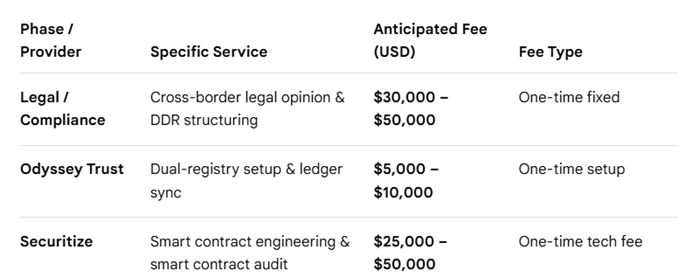
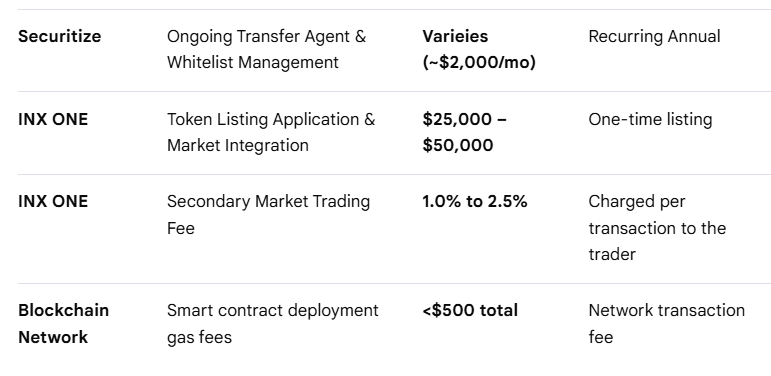
ANTICIPATED FEE MATRIX
Estimated Total: $95,000–$185,000.
Because this is a dual listing of an already public company, meaning audited financials and legal prospectuses are already complete, the costs are expected to be a fraction of a full IPO.
WHY THIS CONFIGURATION IS SEAMLESS
By aligning:
Odyssey Trust — Canada
Securitize — Token Technology Stack
INX ONE — U.S. ATS Platform
a company could potentially avoid building custom software or dealing with traditional clearing infrastructure.
Odyssey handles the Canadian side.
Securitize turns the equity into code.
INX provides the secondary marketplace and access to retail investors.
TOKENIZED DUAL-LISTING TIMELINES
Relying entirely on a standard, standalone S-1 self-registration or an unassisted Regulation A+ process has become a regulatory bottleneck, frequently dragging out for 9 to 18 months due to multiple rounds of SEC comment letters and legal restructuring.
Bypassing this friction involves integrating a token infrastructure provider to compress the timeline and structure the necessary investor digital wallets.
SELF-REGISTRATION TIMELINE: 9–18 MONTHS
Bespoke legal and audit work.
SEC back-and-forth.
Multiple rounds of comments and revisions.
TOKENIZED PIPELINE TIMELINE: 3–5 MONTHS
Weeks 1–4: Legal Synchronization & Registry Setup.
Weeks 5–8: Smart-Contract Configuration & Auditing.
Weeks 9–16: ATS Review.
Weeks 17–20: Whitelisting Launch & Live Trading.
DETAILED MILESTONE BREAKDOWN
WEEKS 1–4: LEGAL SYNCHRONIZATION & REGISTRY SETUP
The company coordinates with a cross-border transfer agent such as Odyssey Trust to establish the Digital Depositary Receipt wrapper.
Concurrently, accountants prepare the required financial disclosures.
WEEKS 5–8: SMART-CONTRACT CONFIGURATION & AUDITING
Securitize deploys compliance-gated smart contracts using the ERC-1404 standard onto a public blockchain such as Avalanche or Solana.
Third-party security firms audit the code to ensure it functions without structural risk.
WEEKS 9–16: ATS LISTING COMMITTEE & SEC NOTIFICATION
Instead of launching a blind self-registration, the company’s legal counsel files an amended Form 1-A or a localized registry update alongside the ATS platform’s internal compliance committee.
Because the trading platform features a standardized, pre-approved structural template, regulatory reviews may move through the pipeline quickly.
WEEKS 17–20: WHITELISTING LAUNCH & LIVE TRADING
The retail onboarding portal goes live, allowing prospective investors to pass verification before the secondary-market order book opens on the ATS.
THE INVESTOR WALLET FRAMEWORK
Digital securities cannot sit in standard Web3 crypto wallets without special constraints.
Because the underlying asset is a legally registered security, the wallet layer must interface directly with the platform’s compliance database to verify the identity of the token holder.
Platforms offer distinct wallet-onboarding frameworks depending on investor preference.
- CUSTODIAL WALLETS — THE WEB2 EXPERIENCE
How It Operates: When a nontechnical retail investor signs up on INX ONE or tZERO, the platform automatically generates a secure, institutional custodial wallet behind the scenes.
The User Interface: The investor logs in using a standard email and password with two-factor authentication.
The investor views token balances exactly like a traditional E*TRADE or Schwab portfolio interface.
Key Advantage: The investor does not need to manage private keys, store backup seed phrases, or buy native crypto assets to cover blockchain transaction fees.
The platform abstracts the technical layer entirely.
- NON-CUSTODIAL WALLETS — THE WEB3 EXPERIENCE
How It Operates: Advanced or crypto-native investors can connect their own personal, self-custody wallets, such as MetaMask, Coinbase Wallet, or a hardware Ledger device.
The Whitelisting Process: Before the wallet can receive a single share token, the investor must link it to a verified profile, such as Securitize iD.
The platform pushes a cryptographic approval signature to the blockchain registry, marking that specific wallet address as compliant.
Smart-Contract Interaction: If a self-custody investor attempts to transfer tokens to an unverified wallet, the underlying smart contract intercepts the transaction onchain and rejects it.
The transfer fails instantly, ensuring that the company does not accidentally allow an unverified entity onto its shareholder registry.
CONCLUSION OF THE WORKING DISCUSSION
The most likely firms to lead small-cap tokenization are the financial firms that already have a foothold in crowdfunding, Regulation A, Regulation CF, broker-dealer infrastructure, and Alternative Trading Systems.
The potential leading players include:
tZERO
Republic / INX
Securitize
The most practical model for a small-cap company may involve maintaining its traditional listing while creating a compliant tokenized layer that provides a new method of investor access and secondary-market trading.
The proposed structure involves:
A traditional CSE or TSX Venture listing.
A Canadian transfer agent and registry structure.
A custody wrapper for the underlying shares.
A regulated tokenization provider.
A compliance-enabled blockchain.
A regulated Alternative Trading System.
A custodial or non-custodial investor-wallet structure.
The estimated cost for a turnkey dual listing was projected at approximately $95,000–$185,000, with a projected timeline of approximately three to five months.
The central opportunity is to solve the chronic problem of small-cap companies that have a traditional U.S. OTC quotation but little or no meaningful trading volume.
Tokenization may provide a new method of investor access, although the effectiveness of the model ultimately depends on the underlying company, investor demand, regulatory structure, and the existence of genuine secondary-market liquidity.